Foot Reflexology Chart: How to Read It and Work Your Own Feet
By DailyDestiny Editorial Team
The short answer
A foot reflexology chart maps the body onto the soles, with the toes matching the head, the ball of the foot the chest, the arch the abdominal organs and the heel the pelvis. The right foot matches the right side of the body, the left foot the left side, and the inner edge of each foot the spine. Use it as a guide for a relaxing self-massage. It cannot tell you what is wrong with your body.
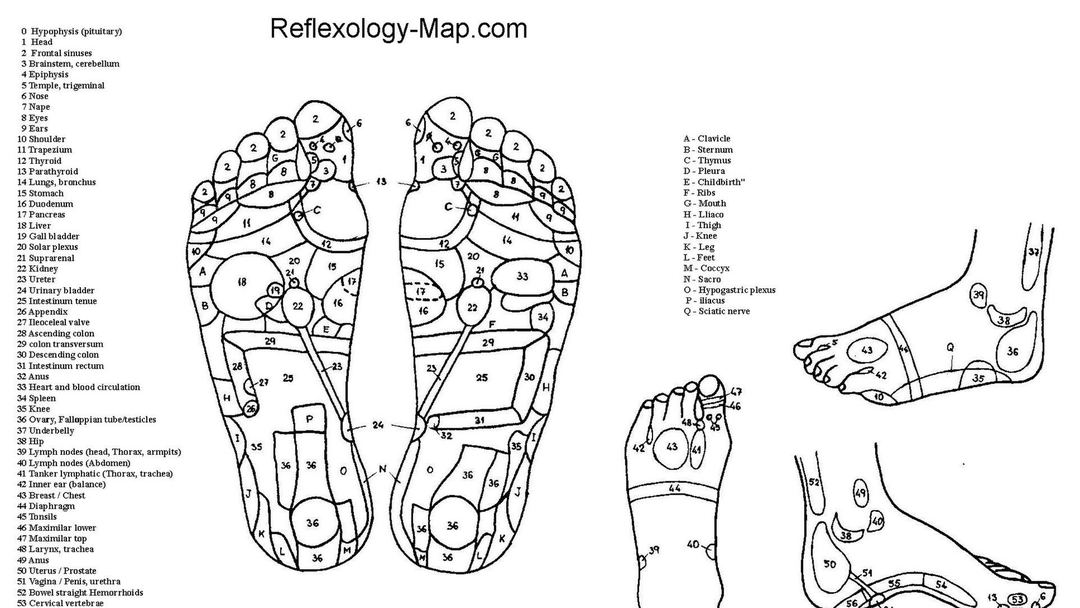
Your feet carry you all day and rarely get any care back. Here is how to read a reflexology chart, work your own feet with the right pressure and timing, and enjoy it honestly, without being sold a diagnosis or a detox.
On this page
How do you read a foot reflexology chart?
Your interest in reflexology says you want to look after your body with your own hands, and a foot chart is the natural place to begin.
Picture yourself at the end of a long day, shoes off, one foot in your lap, and a printed chart full of coloured patches on the sofa beside you. You press your thumb into the arch. It feels good, but you have no idea whether you are on the "kidney" or the "stomach".
Think of the chart as a person lying face down inside your footprints. Read it from toes to heel, and from the inner edge to the outer edge.
Toes: head and neck. The big toe represents the head, with the brain near the tip and the pituitary gland at the centre of its pad. The tips of the smaller toes are labelled sinuses. The base of the big toe is the neck and throat, with the thyroid area on the ball just below it. The ridge under the second and third toes is labelled eyes, and under the fourth and fifth toes, ears.
Ball of the foot: chest. The padded ball represents the lungs and chest, with the shoulder under the little toe on the outer edge. On the left foot, the heart area sits on the inner part of the ball.
The diaphragm line. The line where the ball of the foot meets the arch is labelled the diaphragm. Just below its centre is the solar plexus point, which reflexologists press to relax the whole body.
Arch: digestion and kidneys. The upper arch holds the liver and gallbladder on the right foot, and the stomach, pancreas and spleen mostly on the left. The kidneys and adrenal glands sit in the middle of the arch on both feet. The lower arch holds the small and large intestines.
Heel: pelvis and lower back. The heel represents the pelvis, the lower back and the sciatic nerve.
Inner edge: the spine. The inner edge of each foot, from the big toe to the heel, follows the curve of the spine: neck at the big toe joint, upper back along the ball, lower back along the arch, and sacrum and tailbone at the heel. The bladder point sits on the inner edge, near the heel.
Outer edge: limbs and joints. The outer edge holds the shoulder, arm, elbow, knee and hip.
Top of the foot. The top of the foot is labelled for the chest, breasts and lymph drainage, especially between the long bones.
Why do different foot reflexology charts disagree?
Because charts come from different teachers and schools, and there is no single official map. Most follow Eunice Ingham's layout, but positions of smaller points shift between charts. Pick one clear chart and use it consistently.
What is the solar plexus point used for?
It sits just below the centre of the ball of the foot, under the diaphragm line. Reflexologists press and hold it at the start and end of a session to help the person relax and breathe more slowly.
Who should not do foot reflexology, and when do you need a doctor's go-ahead?
Skip foot reflexology and see a doctor first if you have a suspected or recent blood clot (deep vein thrombosis), an open wound, ulcer or infection on the foot, cellulitis, a foot fracture, active gout in the foot, or diabetes with numb feet. Ask your midwife first if you are pregnant, especially in the first trimester.
For most people, gentle pressure on the feet is very safe. These are the situations where it is not.
Blood clots. Never rub a leg or foot that is swollen, warm, red or painful in a way that could be a deep vein thrombosis. A clot is a medical emergency that needs urgent care. If you have had a recent clot, get your doctor's clearance first.
Diabetes and neuropathy. Nerve damage can stop you feeling how hard you are pressing, and diabetic skin heals slowly, so a bruise can turn into an ulcer. Check your feet every day, use only gentle pressure, and ask your doctor or podiatrist first.
Wounds, ulcers and infections. Do not work over broken skin, blisters, athlete's foot, verrucas, ulcers or areas of spreading redness. Infections can spread, and pressure delays healing.
Fractures, sprains and gout. Leave injured or inflamed joints alone until they have healed.
Pregnancy. Many reflexologists avoid treating in the first trimester, and others work certain points more gently. Talk to your midwife first.
Other cautions. Varicose veins, very low blood pressure, recent surgery, and conditions treated with blood thinners all call for lighter pressure and a word with your doctor. Reflexology is a comfort practice. It should never replace medical care or lead you to stop a medicine.
Can you do reflexology if you take blood thinners?
Gentle pressure is usually fine, but blood thinners make bruising more likely, so avoid deep thumb pressure and check with your doctor. Stop if you see bruises after a session.
Is reflexology safe for people with cancer?
Many cancer centres offer gentle reflexology for relaxation. Cancer Research UK notes some people feel more relaxed and able to cope. Avoid areas near tumours, wounds or blood clots, and ask your cancer team before starting.
Why do the left and right foot reflexology charts look different?
Because each foot maps the same side of the body, the charts differ wherever the organs differ. The right foot has the liver and gallbladder, and the left foot has the heart, stomach and spleen. Points for structures in the middle of the body, like the spine, bladder and head, appear on both feet.
When you search for a right or left foot chart, this is the only real difference you will see.
Right foot only. Liver, a large area in the upper arch on the outer half. Gallbladder, a small point within the liver area. The appendix and ileocecal valve, low on the outer arch near the heel. The start of the large intestine, running up the outer arch.
Left foot only. Heart, on the inner ball of the foot. Spleen, on the outer upper arch. Most of the stomach and pancreas, across the upper arch. The descending colon and sigmoid colon, curving down and towards the inner heel.
Both feet. Head, sinuses, eyes and ears on the toes. Thyroid at the base of the big toe. Lungs on the ball of the foot. Kidneys and adrenal glands in the middle of the arch. Bladder on the inner edge near the heel. The spine along the inner edge. Shoulders, knees and hips along the outer edge.
Top of the foot charts. Charts of the top of the foot show the chest, breast tissue and lymph areas across the upper surface, and the groin and fallopian tube or vas deferens line across the front of the ankle.
Hand charts. Hand reflexology charts copy the same layout onto the palms. They are handy when your feet are sore or you want to practise at your desk.
Where is the stomach on a foot reflexology chart?
On the upper part of the arch, just below the ball of the foot, mainly on the left foot with a smaller area on the inner side of the right foot. It sits beside the pancreas area.
Where is the lower back on a foot reflexology chart?
Along the inner edge of the foot, in the lower arch just in front of the heel. The sciatic area is a band across the heel and up the back of the ankle.
What are thumb walking and the other basic reflexology moves?
Thumb walking is the core reflexology technique: bend and straighten the top joint of your thumb so it inches forward in tiny steps while pressing. Finger walking does the same with the index finger on bony areas. Rotating on a point and the hook and back up move are used for small, precise spots.
Use firm but comfortable pressure, about four to six on a scale where ten is painful.
Thumb walking. Step 1. Rest your fingers on the top of the foot to support it. Step 2. Place the outer edge of your thumb pad on the sole, with the thumb slightly bent. Step 3. Bend the top joint of the thumb a little to press, then straighten it slightly so the thumb creeps forward a few millimetres. Step 4. Repeat, so the thumb walks like a caterpillar in a straight line. Keep your nail short and the steps small. Do not slide or rub.
Finger walking. The same caterpillar action with the side of your index finger. Use it on the top of the foot and around the ankles, where the bones are close to the skin.
Rotating on a point. Press into one spot with your thumb, then make small, slow circles without sliding over the skin. Use it on the solar plexus and on any spot that feels good to linger on.
Hook and back up. Press the thumb into a small point, then pull it slightly back across the point, as if hooking it. It is used for tiny points such as the pituitary at the centre of the big toe.
Relaxing strokes. Between areas, use whole-hand moves: wring the foot gently like a towel, rotate the ankle slowly in both directions, and stroke the sole from toes to heel.
Pressure and comfort. Aim for a pleasant, firm feeling. If a spot is tender, stay on it with lighter pressure for five to ten slow breaths. Never press through sharp pain. Use only a tiny amount of lotion, or none, because slippery skin makes thumb walking impossible.
Why do my thumbs ache after reflexology?
Because thumb walking uses small muscles that are not used to it. Keep your thumb joint slightly bent, never hyperextended, change hands often, and use finger walking or a smooth wooden roller on large areas like the arch and heel.
Can you use a massage ball for self-reflexology?
Yes. Rolling your foot slowly over a tennis ball or a firm massage ball while seated is a good way to work the arch and heel. It is less precise than thumbs but much easier on your hands.
What is a 20-minute self-reflexology routine you can do tonight?
Spend about ten minutes on each foot: warm it up, work the toes, the ball, the arch, the heel and the two edges in that order, then finish by holding the solar plexus point. Sit where you can comfortably rest one ankle on the opposite knee, or use a footstool.
Here is the routine with timings. Start with the right foot, then repeat on the left.
Get comfortable. Sit on a sofa or the floor with your back supported. Wash and dry your feet. Rest your right ankle across your left thigh, or put your foot on a cushioned stool in front of you.
Minute 1. Warm up. Hold the foot in both hands. Wring it gently, rotate the ankle slowly five times each way, and stroke the sole from toes to heel three times.
Minutes 2 to 3. Toes. Thumb walk up the pad of the big toe in three lines, then up each smaller toe. Hook and back up at the centre of the big toe pad. Gently squeeze the tip of each toe.
Minutes 3 to 4. Base of the toes and ball. Thumb walk across the ridge under the toes, then across the ball of the foot in horizontal lines from the inner edge to the outer edge.
Minutes 4 to 6. Arch. Thumb walk across the upper arch in horizontal lines, then the lower arch. Work slowly. This is the area most people find soothing.
Minutes 6 to 7. Heel. The skin is thick, so press a little more firmly, or use your knuckles. Work across the heel in lines.
Minutes 7 to 8. Inner edge. Thumb walk along the inner edge from the heel up to the big toe, following the curve of the arch. This is the spine area.
Minute 8 to 9. Outer edge and top. Finger walk along the outer edge from heel to little toe, then gently finger walk between the long bones on the top of the foot towards the ankle.
Minute 9 to 10. Close. Press and hold the solar plexus point, just below the centre of the ball, with your thumb for five slow breaths. Finish with three long strokes from toes to heel.
Then switch to the left foot. Drink some water, and rest for a few minutes before you get up.
Which reflexology points help with sleep?
People often focus on the solar plexus point, the big toe pad and a slow, gentle full-foot routine before bed. There is no strong evidence that particular points cause sleep, but a quiet ten minutes of foot massage can help you relax and wind down.
Should reflexology make you feel sleepy or emotional?
Feeling relaxed, sleepy or briefly teary is common after any calming touch. It usually passes within an hour. Feeling unwell, dizzy or in pain afterwards is not expected, so lighten the pressure next time and see a doctor if it continues.
Who invented reflexology, and how old is it really?
Modern foot reflexology was created in the twentieth century. It grew out of zone therapy, published by American doctor William Fitzgerald with writer Edwin Bowers in their 1917 book Zone Therapy, and was turned into a foot map by Eunice Ingham, a physiotherapist, in the 1930s. Her 1938 book Stories the Feet Can Tell is the basis of most charts.
Claims that reflexology is thousands of years old rest on much looser evidence.
Zone therapy. Fitzgerald, an ear, nose and throat doctor, claimed that pressure on one part of the body could ease pain in another part of the same zone. He divided the body into ten vertical zones, five on each side, running from the head to the fingers and toes. Bowers first wrote about the idea in a 1915 magazine article and then co-wrote the 1917 book with him.
Eunice Ingham. Working with Dr Joe Shelby Riley, who had developed Fitzgerald's zones further, Ingham focused on the feet and mapped specific organs onto specific areas of the soles. She published Stories the Feet Can Tell in 1938 and taught her method for decades until her death in 1974. Her nephew Dwight Byers carried on her teaching. Almost every modern foot chart traces back to her.
The "ancient" story. A carved scene in the tomb of Ankhmahor at Saqqara in Egypt, often called the physician's tomb, shows people having their hands and feet worked on, and it is often presented as proof of ancient reflexology. Scholars disagree about what it shows: massage, reflexology, surgery, or a simple manicure and pedicure. Foot massage is clearly old and found in many cultures. The idea of a detailed organ map on the sole is modern.
Knowing this does not make reflexology less pleasant. It simply means you can enjoy it as a relaxing modern practice without needing to believe ancient claims.
Is reflexology from Chinese medicine?
Not originally. Western reflexology comes from Fitzgerald and Ingham. Foot massage has a long history in China and elsewhere, and some Asian schools blend reflexology with acupressure, which is why the two are often confused.
What is zone therapy?
It is Fitzgerald's early twentieth-century idea that the body is divided into ten vertical zones, and that pressure in one part of a zone affects other parts of the same zone. Reflexology charts grew out of it.
Is there any scientific evidence that reflexology works?
Reflexology can help people feel relaxed, but there is no convincing evidence that it treats any medical condition. In 2009, Edzard Ernst reviewed 18 randomized controlled trials in the Medical Journal of Australia and concluded that the best evidence did not convincingly show reflexology works for any condition.
That makes it a pleasant comfort practice. Keep your medical care for medical problems.
The main reviews. Ernst found 217 trials related to reflexology and kept 18 randomized controlled trials of reasonable quality. Twelve did not convincingly show any benefit, five suggested positive effects, and one was unclear. Many studies were small and poorly designed. A 2011 update with colleagues, covering 23 studies, reached a similar conclusion.
Diagnosis. In a blinded study published in 2000, White, Williamson, Hart and Ernst asked two reflexologists to examine the feet of 18 patients with known conditions without being told what those conditions were. The authors concluded that reflexology did not appear to be a valid method of diagnosis.
Relaxation and coping. Cancer Research UK says there is no scientific evidence that reflexology can cure or prevent any disease, but notes some evidence that it can help people relax, cope with stress and anxiety, and lift mood, mainly from small studies. That is the most honest summary: it feels good, it can calm you, and that has value.
Why it may feel helpful. Kind touch, warm hands, quiet time and slow breathing all help people relax, whatever chart is used. You do not need the organ map to be literally true to enjoy that.
Does reflexology help anxiety?
Some small studies report lower anxiety after reflexology, which fits with its relaxing effect. The research is not strong enough to call it a treatment. It can be a soothing part of self-care alongside proper support.
Is reflexology better than an ordinary foot massage?
There is no good evidence that it is. Studies that compare reflexology with a general foot massage usually find similar relaxation. Choose whichever you enjoy and can do most easily.
Which reflexology claims, detox foot pads and foot baths are scams?
The clearest scams are reflexologists who claim to diagnose disease from your feet, "detox" foot pads that turn dark overnight, ionic foot baths that turn brown, and expensive online "certifications" with no hands-on training. The US Federal Trade Commission took action against the marketers of Kinoki detox foot pads, which ended in a $14.5 million judgment, suspended because they could not pay, and a ban on selling a wide range of products.
Here is how each one works, so you can recognise it.
Diagnosis from the feet. A reflexologist who tells you that a tender spot means you have a liver, kidney, thyroid or cancer problem, and then sells a package of sessions to fix it, is going beyond what the evidence supports. The 2000 blinded study found reflexology was not a valid diagnostic method. A good reflexologist never diagnoses and always tells you to see a doctor about symptoms.
Detox foot pads. These stick to the soles overnight and turn brown or black, which sellers say shows toxins being pulled out. In January 2009, the FTC charged the marketers of Kinoki foot pads, Yehuda Levin and his company Xacta 3000, with false claims that the pads removed heavy metals, toxins, parasites and cellulite and treated conditions such as depression, diabetes and high blood pressure. In 2010 the defendants agreed to a judgment of $14.5 million, the total revenue from the pads, which was suspended because they could not pay, and a court banned them from selling a wide range of products. The dark colour is widely explained by moisture, such as sweat, reacting with ingredients like wood vinegar. Lab tests reported by medical writers have not found toxins in used pads.
Ionic foot baths. You put your feet in salty water with an electrical device, the water turns orange or brown, and you are told it is your toxins. A 2012 study in the Journal of Environmental and Public Health tested the IonCleanse footbath and found no sign that it pulled toxic elements out through the feet. The colour change is generally put down to corrosion of the metal electrodes and impurities in the water.
Certification mills. Some websites sell "reflexology certification" in an afternoon online for a small fee, with no supervised practice. That certificate carries no regulated standing. In the US, the American Reflexology Certification Board requires a 200-hour course, including at least 30 hours of practical instruction, before candidates can sit its exam. In the UK, the Complementary and Natural Healthcare Council keeps a voluntary register of reflexologists who meet its standards. Neither makes reflexology a medical treatment, but both tell you a practitioner trained properly.
Treatment packages. Be cautious of anyone who insists you need ten or twenty prepaid sessions to "clear" a problem. You can enjoy reflexology session by session.
What does a good reflexologist look like?
They ask about your health and medicines before starting, never diagnose, explain that reflexology is for relaxation and wellbeing, use clean hands and towels, and tell you to see a doctor about anything worrying. They are happy to show their training and membership of a professional body.
Why does detox foot bath water change colour?
Because the device passes current through salty water, and the metal electrodes corrode and react with the water.
Should you do self-reflexology at home or book a reflexologist?
Self-reflexology is free, safe for most people and a lovely evening habit, so start there. Book a trained reflexologist if you want a deeper, fully relaxing session you do not have to do yourself, or if your hands, hips or back make reaching your own feet difficult.
Either way, think of it as care for your feet and your nervous system, alongside whatever medical care you need.
When self-reflexology is the better choice. You want a short, regular wind-down routine. You like learning with your hands. You want to keep costs at zero. Ten minutes per foot, two or three times a week, is plenty.
When a professional session is worth it. You want to lie back and fully let go. You have trouble bending to your feet. You want someone to adjust pressure for a sensitive condition, such as during cancer care, where many hospital teams offer gentle reflexology for comfort.
Questions to ask before booking. What training have you done, and with which body? Are you insured? Do you ever diagnose? What happens in a first session? The right answers are a proper course, yes to insurance, no to diagnosis, and a health questionnaire before you take your shoes off.
Make it part of a wider routine. Many people pair self-reflexology with a warm foot soak, slow breathing or a short walk barefoot on grass. If the barefoot side interests you, our guide Grounding and Earthing looks at it honestly.
A last word on your feet. Look at them while you work. New numbness, colour changes, sores that do not heal, or swelling are worth showing to a doctor or podiatrist, whatever any chart says.
Can you do reflexology on a partner?
Yes. The same routine works on someone else, and it is often easier because you can sit facing their feet. Ask about any health conditions first, check in about pressure, and keep the session gentle.
What should you do after a reflexology session?
Drink some water, sit quietly for a few minutes and get up slowly. Many people sleep well afterwards. If you feel unwell or a spot stays painful the next day, rest and lighten the pressure next time.
Questions people ask
What is the difference between the left and right foot on a reflexology chart?
Each foot maps the same side of the body. The right foot holds the liver and gallbladder points, and the left foot holds the heart and spleen points, because those organs sit on those sides. Points for midline structures, such as the spine, bladder and brain, appear on both feet.
Is there a different foot reflexology chart for women and men?
The layout is the same. Charts labelled female or male only change the names of the reproductive points. The uterus or prostate point sits on the inner side of the heel, below the inner ankle bone, and the ovary or testicle point sits on the outer side, below the outer ankle bone.
Can a reflexologist tell what is wrong with you from your feet?
No. A blinded study by White and colleagues, published in 2000, found that reflexologists examining patients' feet could not reliably identify their medical conditions. A tender spot on your foot is not a diagnosis. If you are worried about a symptom, see a doctor.
Why does one spot on my foot hurt during reflexology?
Tender spots are usually local: a tight muscle, a callus, a strained ligament, a corn or simply a sensitive area. Reflexology tradition links tenderness to the matching body part, but there is no good evidence for that link. Ease off the pressure, and see a podiatrist if a spot hurts during normal walking.
How often should you do self-reflexology?
Two or three times a week is plenty for most people, and daily is fine if it feels good. Ten minutes per foot is enough. Many people like doing it in the evening because it helps them wind down before bed.
Can reflexology induce labour?
There is no good evidence that reflexology starts labour. Some reflexologists avoid certain points in early pregnancy as a precaution, and many treat pregnant clients only after the first trimester. If you are pregnant, ask your midwife first and see a reflexologist trained in pregnancy care.
Is a foot reflexology chart the same as an acupressure chart?
No. Reflexology charts come from the zone therapy of William Fitzgerald and the maps of Eunice Ingham in the twentieth century. Acupressure points come from Chinese medicine and lie along channels across the whole body. A few spots overlap by chance, but the systems are different.
What does today hold for you?
Pop in your birthday. Your reading shows up right here. No email, no account.
Related topics: foot reflexology chart, reflexology foot chart, foot reflexology map, foot reflexology chart right foot, foot reflexology chart top of foot, foot reflexology chart female, self reflexology foot massage, self reflexology for sleep