Mantra Meditation: How to Choose a Mantra and Practise Japa Daily
By DailyDestiny Editorial Team
The short answer
Mantra meditation means repeating a sound, word or short phrase, aloud or silently, and gently returning to it each time the mind wanders. Choose a traditional mantra such as Om or So Hum, or a neutral word, sit for 10 to 20 minutes once or twice a day, and if you like, count repetitions on a mala of 108 beads.
You want a practice with roots, words people have repeated for thousands of years, not just another calm voice in an app. Here is how to choose a mantra, how to repeat it, how to count it on a mala, and what is worth paying for.
On this page
How does mantra meditation work, in plain terms?
You want more than a quiet minute between meetings; you want words with roots, sounds people have repeated for thousands of years. Mantra meditation can give you exactly that.
You have tried following your breath, and your mind kept drifting back to your inbox. Then a friend mentions that she repeats one word, silently, for twenty minutes each morning. It sounds almost too simple. You wonder which word, and whether the word even matters.
The word mantra comes from Sanskrit. It is often explained as "a tool for the mind". Mantras appear throughout the Vedas, the oldest Hindu scriptures, and later in Buddhism, Jainism and Sikhism. Repeating a mantra is called japa.
The mechanism is simple. The mind needs something to do. In breath meditation it watches the breath. In mantra meditation it holds a sound. Each time it wanders and you bring it back to the sound, you train attention, the same way repeated lifts train a muscle.
Many people find a mantra easier than the breath, because a sound is more vivid than air moving in the nostrils. It fills the space where worries would otherwise sit. Over time, the mantra can begin to repeat itself quietly in the background, which practitioners describe as one of the most settling parts of the practice.
Check with a doctor or therapist first if you live with psychosis, severe depression or PTSD and plan long or intensive practice, such as a retreat. Short daily mantra practice is gentle and suits most people. If you have asthma or a voice condition, keep spoken chanting soft and short, and favour silent repetition.
Is mantra meditation religious?
It can be, and it does not have to be. In Hindu and Buddhist practice, many mantras are prayers to a deity or expressions of a teaching. You can also repeat a neutral word with no religious meaning. Choose what fits your beliefs.
What does japa mean?
Japa is the Sanskrit word for repeating a mantra, usually counted on beads. Japa can be spoken, whispered or silent. It is one of the oldest and most widespread meditation methods in India.
Which mantra should you choose as a beginner?
Pick a short mantra whose sound you like and whose meaning sits well with you. Om, So Hum, Om Mani Padme Hum and Om Namah Shivaya are four of the most widely used, and each has a different feel and history. A neutral word such as "one" also works if you prefer a secular practice.
Om (or Aum). The most sacred sound in Hinduism, also used in Buddhism and Jainism. A whole short Upanishad, the Mandukya, is devoted to it. Chanted aloud, it is often stretched into three parts, A, U and M, followed by silence. It is a good choice if you want a single, deep sound.
So Hum. Often translated as "I am that". It is used with the breath: "so" on the in-breath and "hum" on the out-breath. Because it follows the breath, it suits silent practice and is a natural bridge if you already do breath meditation.
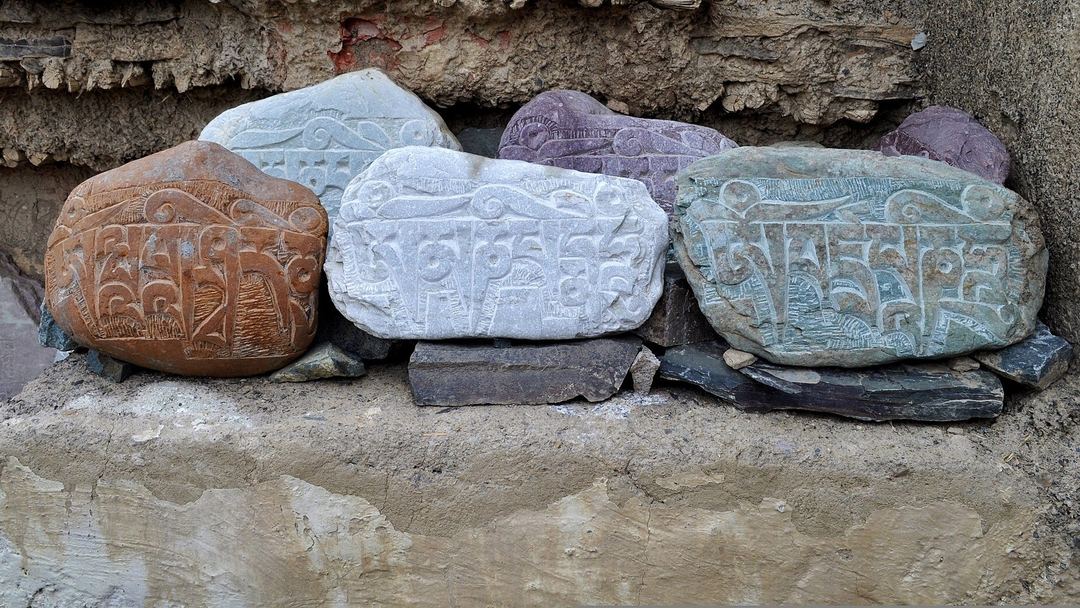
Om Mani Padme Hum. The six-syllable mantra of Avalokiteshvara, the bodhisattva of compassion, called Chenrezig in Tibet. It is carved on stones, printed on prayer flags and turned in prayer wheels across Tibetan Buddhist regions. It suits people drawn to a compassion practice. If loving-kindness is your main interest, a metta practice with simple phrases may suit you even better.
Om Namah Shivaya. "I bow to Shiva", or to the auspicious one. Known as the five-syllable mantra, it appears in the Shri Rudram of the Yajurveda. It is one of the most widely chanted mantras in Hinduism and is often recommended as open to anyone, regardless of initiation.
A neutral word. In his 1975 book The Relaxation Response, the Harvard cardiologist Herbert Benson suggested silently repeating the word "one" on each out-breath, for 10 to 20 minutes. He chose it for its simplicity and neutrality. Words such as "peace" work too.
Respect for living traditions. These mantras belong to living faiths. Learn the meaning, pronounce them as carefully as you can, and avoid treating them as decoration. Some lineages teach that certain mantras, such as the Gayatri, should be received from a teacher. If you join a lineage, follow its guidance.
Can you use an English mantra?
Yes. Short phrases such as "peace", "let go" or "I am here" work for many people. Keep it brief and calm, and avoid phrases that set goals or make demands, which tend to stir the mind rather than settle it.
How do you pronounce So Hum?
"So" rhymes with "go". "Hum" sounds like "hum" in "humble", softly. On a silent practice, let "so" ride the in-breath and "hum" the out-breath, without forcing the breath to match.
What is a bija mantra?
A bija, or seed, mantra is a single syllable, such as Om, Hrim or Lam. Bija sounds for each chakra, such as Lam and Vam, are also used in chakra practice, which the guide Chakra Meditation covers.
How do you practise mantra meditation step by step?
Sit comfortably, close your eyes, start the mantra, and each time you notice your mind has wandered, return to it gently. That is the whole method. The details below help it go smoothly.
Step 1. Choose your mantra and your time. Morning, before breakfast, is traditional, but any regular time works. Set a timer for 10 minutes to start.
Step 2. Sit upright on a chair or cushion. Rest your hands on your thighs or in your lap. Take three slow breaths to settle.
Step 3. Begin the mantra aloud, at a comfortable pitch, for a minute or so. This helps you find its rhythm.
Step 4. Let the mantra get quieter, to a whisper, for another minute or two.
Step 5. Let it become silent, repeated in your mind only. Keep a relaxed, easy pace. You do not need to concentrate hard. Simply prefer the mantra over other thoughts.
Step 6. When you notice you have drifted into thinking, which will happen often, return to the mantra without frustration. Every return is a repetition of the real exercise.
Step 7. When the timer sounds, stop repeating. Sit quietly for a minute or two before you open your eyes. Rushing straight into your day can feel jarring.
What it should feel like. Some days the mantra flows easily and the mind feels spacious. Other days you spend most of the session lost in plans, coming back again and again. Both count. The second kind may even be doing more training.
Common mistakes. Pushing too hard is the most common. Gripping the mantra creates tension. Treat it like a melody humming in the background, not a task. Another mistake is speeding up. If the mantra races, slow it down. A third is judging each session. Give the practice a month before deciding whether it works for you.
How to tell it is working. Look at your life, not just your sessions. Do you return to calm a little faster after stress? Are you a little less reactive in traffic or at work? These small shifts are the real signs.
Should the mantra follow the breath?
Some mantras, such as So Hum, are tied to the breath. Others, such as Om Namah Shivaya, can flow at their own pace. If linking a mantra to the breath feels forced, let them run separately.
What if you fall asleep?
It happens, especially if you are tired. Sit more upright, practise earlier in the day, or open your eyes slightly. If you are falling asleep often, you may simply need more rest.
Is it better to chant a mantra aloud, whisper it or repeat it silently?
All three are traditional, and each has a place. Spoken chanting is easiest for beginners and for days when the mind is busy. Whispering is quieter and more inward. Silent repetition is the most subtle, and many traditions regard it as the most powerful.
Hindu tradition names three levels. Vaikhari japa is spoken aloud. Upamshu japa is whispered, so that only you can hear it, with the lips moving. Manasika japa is purely mental. Traditional texts often rank silent repetition highest, while also accepting that most people begin with sound.
When to chant aloud. Chanting aloud suits groups, devotional settings and days when silent practice keeps sliding into daydreams. It also brings the breath into a long, slow rhythm, because each chant uses a long out-breath. Keep the voice soft. Chanting should never strain your throat.
When to whisper. Whispering is good when you share a home or an office. It keeps the physical anchor of moving lips without disturbing anyone.
When to go silent. Silent repetition works best once you know the mantra well. It is the form most often used in meditation on a cushion, on trains and in waiting rooms.
Moving between them. A common routine starts aloud, moves to a whisper, then settles into silence, as in the step-by-step guide above. You can also go the other way: if silence turns into wandering, bring the voice back for a few rounds.
Chanting with others is a related but different practice. Kirtan, the call-and-response singing of mantras, is closer to music, and it can be joyful and moving in a way silent practice is not.
Does chanting Om vibrate the body?
When chanted aloud on a long out-breath, Om creates a felt vibration in the chest, throat and head. Many people find that sensation grounding. Any spiritual meaning given to the vibration is a matter of tradition rather than measurement.
Can you chant mantras with music?
Yes. Many recordings set mantras to music, and chanting along can be a lovely practice. For meditation, many people prefer silence afterwards, so the mind can rest in the stillness the chant leaves behind.
How do you count japa on a 108-bead mala?
Hold the mala in your right hand, start at the bead next to the larger guru bead, and move one bead toward you with your thumb for each repetition. When you reach the guru bead again, you have completed 108. Turn the mala around rather than crossing the guru bead if you want another round.
In many Hindu traditions, the mala rests over the middle finger and the thumb moves each bead, while the index finger stays out of the way. Tibetan Buddhist practice often uses the left hand. Follow the tradition your mantra comes from, or the one you were taught.
Why 108? The number is sacred in Hinduism, Buddhism and Jainism, and many explanations are given, from the 108 Upanishads named in one tradition to astrological counts. No single reason is agreed. For a fuller look at the count, the materials, and how to choose one, see the guide Mala Beads: The 108 Count, How to Use One and Choosing Yours.
Rounds and counting. One round is 108 repetitions. Many practitioners do one, three or eleven rounds a day. Some use a small counter bead on a side string to tally rounds. A full round of a short mantra such as Om takes most people a few minutes. A longer mantra takes more.
Do you need a mala at all? No. A mala is a counting tool and a focus for the hands. It helps people who like structure and who find it calming to touch something. You can also simply set a timer.
Care and respect. Many practitioners keep their mala off the floor and out of bathrooms, and store it in a small bag. This is custom, not rule, but it reflects how much the object means to people who use it.
Why do you not cross the guru bead?
In tradition, the guru bead represents the teacher or the goal, so you turn back at it as a sign of respect. Practically, it also marks the end of a round, so you always know your count.
Can you use a 27-bead or 54-bead mala?
Yes. Shorter malas are factors of 108, so four rounds of 27 or two of 54 still make 108. They are handy for wrists and pockets.
What is Transcendental Meditation, and what does the TM course really cost?
Transcendental Meditation, or TM, is a trademarked mantra technique taught by certified teachers in a set four-day course. You practise it for 20 minutes twice a day, sitting comfortably with your eyes closed. In the United States, tm.org listed a one-time course fee of 680 to 1,480 dollars in November 2026, based on household income, with a separate fee for students.
TM was brought to the world by Maharishi Mahesh Yogi, an Indian teacher who began teaching it in the 1950s and made it famous in the West in the following decades. Each student receives a mantra in a private session with a teacher, who chooses it. Students are asked to keep the mantra private.
What the fee buys. The official site sets the fee by household income, from 680 dollars at the lowest band to 1,480 dollars at the highest. The fee can be split into four monthly payments, and partial scholarships may be available. It covers personal instruction, three further sessions in person or in a hybrid format, six further group sessions over the following four months, a full-day meditation retreat and access to the TM app. Fees differ in other countries, so check your national TM site.
How TM mantras are chosen. TM teaches that a teacher selects a suitable mantra for each person. In 1984, Omni magazine published 16 mantras that it said came from disaffected TM teachers, and scholars of new religious movements have described the mantras as assigned by age and gender. The TM organisation keeps the selection process private.
Who TM suits. Some people value a structured course, a personal teacher and lifelong follow-up, and they find the fee worthwhile. Others prefer to learn a traditional mantra free. Both paths can lead to a steady practice. What matters is that you know what you are paying for, and that the price is clear before you start, which with TM it is.
Can you learn TM from a book or video?
Not officially. The TM organisation teaches only through its certified teachers. Many books describe similar mantra techniques, and those can work well, but they are not TM by name.
Is TM a religion?
TM presents itself as a non-religious technique. Its roots are in Hindu tradition, and the instruction includes a short ceremony of gratitude to the teacher's lineage. People of many faiths practise it.
How do you spot a fake mantra seller or a counterfeit mala?
Be wary of anyone selling a "secret personal mantra", a "mantra activation", or a mala that is "energised" for a high price, and check rudraksha beads for carving, glue and moulding. The traditional mantras above are freely chanted, and you never need to pay for a mantra to begin.
Secret mantras for a fee. Websites and social media sellers offer to calculate your "personal Vedic mantra" or "birth mantra" from your date of birth, or to reveal "your TM mantra", for a payment. None of these is TM, which teaches only through certified teachers at its published fees. And no Hindu or Buddhist tradition needs a stranger online to sell you a hidden word.
"Activation" and "siddhi" fees. Some sellers claim a mantra is useless until they activate it, perform a ritual to give it power, or grant "mantra siddhi" for a fee. Some ask for further payments when results do not come. In living traditions, initiation is given within a relationship with a teacher, often after years. It is not a one-off online transaction priced in tiers.
Fake rudraksha beads. Rudraksha are the seeds of the Elaeocarpus ganitrus tree, prized for malas. Fakes are common. Watch for these signs. Om signs, tridents or snakes carved into the bead, since natural beads do not carry symbols. Beads glued together, or extra face lines cut in to pass a common bead off as a rare one. Plastic, resin or carved wood beads, which look too uniform and identical. And "one-faced" round beads at bargain prices, because a genuine single-faced bead is very rare. Simple tests such as floating or boiling are unreliable, so do not trust a seller who relies on them.
Fair prices. Five-faced rudraksha beads are the most common, and a plain mala of them should be modestly priced. Sandalwood, tulsi and glass malas are inexpensive too. If a seller charges a large premium for "energising", "blessing" or a "lab certificate" they issued themselves, you are paying for a story. If authenticity really matters to you, buy from a long-established seller who sells everyday beads openly and lets you return goods.
Fake sandalwood and dyed beads. Cheap "sandalwood" malas are often ordinary wood soaked in fragrance oil, which fades within weeks. It does not harm your practice, but it should not cost the price of real sandalwood.
Does a mala need to be blessed before use?
Some traditions bless a new mala in a simple ceremony at home or in a temple, often without charge. A blessing is a matter of faith. Paying a large premium for one sold online adds nothing to the beads.
What is a fair price for a mantra class?
Community classes at temples, yoga studios and meditation centres are often free or low-cost, sometimes on donation. A clear, published fee for a course with a named teacher is fair. Hidden or escalating fees are not.
What does the research say about mantra meditation and TM?
The research is mixed and, overall, less strong than for mindfulness. Mantra meditation reliably helps many people relax, but high-quality trials are few, and much of the TM research has been questioned for bias.
In 2014, a review in JAMA Internal Medicine by Madhav Goyal and colleagues examined meditation trials with active comparison groups. Very few mantra programs met its standards. For those that did, it found low evidence of no effect, or insufficient evidence of any effect, on stress-related outcomes such as anxiety and depression. The authors noted that the small number of trials limited what they could conclude.
Blood pressure. In 2013, an American Heart Association scientific statement on alternative ways to lower blood pressure said TM may be considered in clinical practice, though with limited evidence. Other meditation techniques were not recommended for that purpose. A 2008 meta-analysis in the American Journal of Hypertension estimated that regular TM practice might lower systolic and diastolic blood pressure by about 4.7 and 3.2 mm Hg.
Concerns about bias. In 2004, Canter and Ernst reviewed TM blood pressure trials in the Journal of Hypertension. They concluded there was insufficient evidence to say whether TM lowers blood pressure, because the trials had important weaknesses and could be biased by the authors' links to the TM organisation. Earlier, a 2007 report for the US Agency for Healthcare Research and Quality found that most meditation studies of all kinds were of poor quality.
The relaxation response. Herbert Benson's work in the 1970s showed that repeating a simple word in a calm setting reliably produced a set of physical changes he called the relaxation response, such as slower breathing and heart rate. That finding is the most solid foundation for mantra practice: it calms the body.
Where tradition speaks. Claims that particular mantras grant blessings, purify karma or bring liberation are spiritual teachings. You can hold them as faith, but they are not tested claims. Mantra meditation should never replace medical treatment.
Can mantra meditation help anxiety?
Many people find it calming, and it can be a good part of an anxiety toolkit. Trial evidence for mantra specifically is limited. If anxiety disrupts your life, see a doctor or therapist, and use mantra alongside that care.
Is TM better than other mantra meditation?
There is no strong evidence that TM works better than other mantra methods taught well. The TM course offers structure and support, which some people value. Others do just as well with a free traditional mantra and a daily habit.
What daily mantra routine actually lasts?
Keep it short, keep it at the same time, and tie it to something you already do. Ten minutes after your morning shower, or one round of the mala before bed, will last longer than a grand plan you abandon by Thursday.
A simple starter routine: in the morning, sit for one round of 108 repetitions, starting aloud and moving to silence. In the evening, sit for five to ten minutes of silent repetition. On busy days, a single round on the train still counts.
Keep a tiny log. A tick on a calendar or a note in your phone keeps you honest and shows progress. Many practitioners count rounds and enjoy watching the total grow.
Commit to a span. Some traditions encourage a fixed commitment, such as a set number of days of daily japa, to build discipline. You do not need a special number. Choose a span that feels like a stretch but not a strain, such as thirty days, and see what changes.
Carry the mantra into the day. Repeat it silently while walking, washing up or waiting. This keeps the sound fresh and steadies you in small stressful moments.
When it goes flat. Every practice goes through dry patches. Do not chase new mantras. Try chanting aloud for a week, practising at a new time, or joining a group. Then return to the quiet form.
Over months, many practitioners notice the mantra arising on its own, a soft sound under the noise of the day. That quiet companion is one of the gifts of the practice, and it costs nothing at all.
Is morning or evening better for mantra meditation?
Tradition favours early morning, when the mind is fresh and the house is quiet. Evening practice helps many people unwind. The best time is the one you will keep.
What if you miss a day?
Start again the next day without guilt. A practice is a long rhythm, not a perfect streak. One missed day changes nothing. Months of steady practice change a lot.
Questions people ask
What is the best mantra for a beginner?
A short, easy sound you feel comfortable with. Om and So Hum are the most common starting points, because they are short and fit the breath. If you prefer a secular option, a calm neutral word such as "one" works, as Herbert Benson showed in his relaxation research in the 1970s. The best mantra is the one you will actually repeat every day.
How long should you do mantra meditation?
Ten to twenty minutes once or twice a day is a good range. One full round of 108 repetitions on a mala takes most people somewhere between five and fifteen minutes, depending on the mantra's length and your pace. Start small and add time once the habit is steady.
Do you need a guru to give you a mantra?
Some lineages teach that certain mantras should be received from a teacher in an initiation, and if you follow such a lineage, it is respectful to honour that. Many widely chanted mantras, such as Om, So Hum, Om Mani Padme Hum and Om Namah Shivaya, are openly practised by lay people. You do not need to buy a secret mantra to begin.
Can you change your mantra?
You can, but most teachers advise keeping one mantra for a long time. The value builds through repetition and familiarity. Switching every week keeps the mind busy choosing rather than settling. If a mantra truly does not suit you after a month or two, choose another and stay with it.
Is mantra meditation better than breath meditation?
Neither is better for everyone. Mantra gives a busy mind more to hold onto, which many beginners find easier. Breath meditation needs nothing but your body and may suit people who dislike words. Studies have not shown one style clearly beating the other, so choose the one you enjoy enough to keep.
Does the meaning of the mantra matter?
Traditions differ. In Hindu and Buddhist practice, the sound and its meaning are both considered important, and knowing the meaning deepens devotion. In research settings, neutral words produced relaxation too. If you choose a sacred mantra, it is respectful to learn what it means and where it comes from.
How much does Transcendental Meditation cost?
In the United States, tm.org listed the one-time course fee in November 2026 on a sliding scale by household income, ranging from 680 dollars to 1,480 dollars, with a separate fee for students. The fee covers a four-day course with personal instruction, further group sessions over the following four months and a full-day retreat, and can be paid in four instalments.
What does today hold for you?
Pop in your birthday. Your reading shows up right here. No email, no account.
Related topics: mantra meditation, how to do mantra meditation, mantra meditation for beginners, how to do mantra japa with mala, mantra for meditation examples, mantra meditation benefits, mantra meditation for anxiety, mantra meditation vs breath meditation, transcendental meditation cost