Maslow's Hierarchy of Needs: Complete Guide Through a Spiritual and Astrological Lens
By DailyDestiny Editorial Team

If you have everything you thought you needed and still feel restless, Maslow's Hierarchy of Needs may explain why. Abraham Maslow's 1943 five-level theory of motivation, mapped onto the chakras and zodiac archetypes.
On this page
What Is Maslow's Hierarchy of Needs and Why Does It Matter?
Imagine you finally have the steady job, the decent home and the people you love around you. Everything you once worked so hard for is in place. And yet you wake up on a Tuesday feeling strangely flat, wondering why it is not enough.
The short answer: Maslow's Hierarchy of Needs explains that feeling. It is a five-level model of motivation proposed by psychologist Abraham Maslow in his 1943 paper "A Theory of Human Motivation." Once your basic needs are met, the old fuel stops working, and a different need, the need to grow, starts calling.
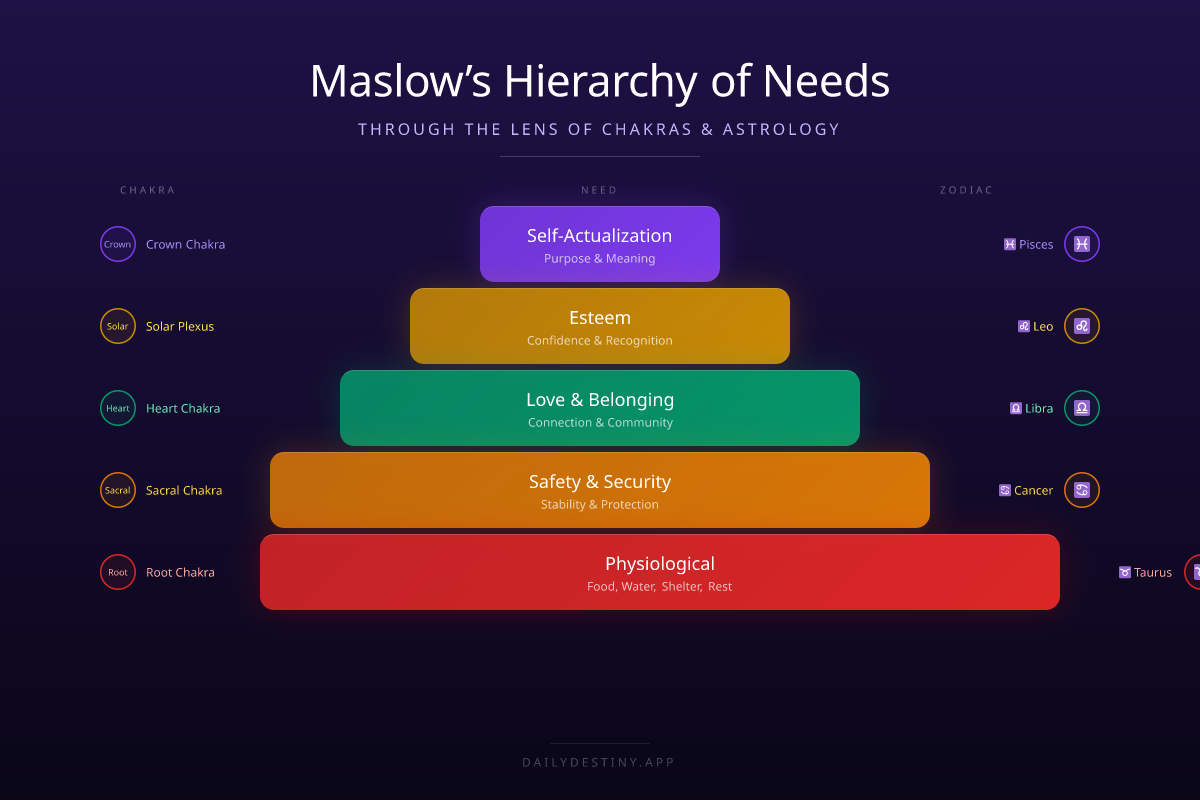
The theory says people meet basic needs before moving on to higher psychological and self-fulfillment needs. It is usually drawn as a pyramid, physiological needs at the base and self-actualization at the peak.
It shifted psychology from pathology to potential. Freud asked what goes wrong with people, and behaviorists studied conditioned responses. Maslow asked what goes right, studying exemplary individuals including Albert Einstein, Eleanor Roosevelt, Frederick Douglass and William James. Once lower needs are reasonably met, he suggested, people naturally move toward higher ones, a process he called growth motivation.
Why does it matter to you? It shows which need is most pressing right now and where to put your energy. In leadership, it explains why employees need more than a paycheck. In education, why students cannot learn when basic needs are unmet. In healthcare, why treating the whole person, not just symptoms, produces better outcomes.
Most strikingly, the hierarchy maps onto spiritual models from traditions far older than Maslow. Many see this as a sign he independently found a pattern contemplatives had charted through inner investigation before psychology existed.
Maslow co-founded the humanistic psychology movement with Carl Rogers and Rollo May. It arose in the 1950s against psychoanalysis, focused on unconscious drives and pathology, and behaviorism, which reduced experience to stimulus and response. Maslow argued both missed the human capacity for growth, creativity and self-direction.
He was influenced by his study of the Blackfoot (Siksika) Nation in Alberta, Canada, a culture that seemed to meet its members' needs at several levels at once. Recent scholarship by Cindy Blackstock and others highlights Indigenous influences under-acknowledged in his published work, suggesting the hierarchy may owe more to Indigenous worldviews than to purely Western observation.
How did Maslow develop the hierarchy?
He studied the biographies and traits of people he considered self-actualized, including Einstein, Lincoln, Roosevelt and others, and drew on his time with the Blackfoot Nation in Alberta.
Instead of disorders, he studied psychological health, asking what marks the most fulfilled and effective people. In a field dominated by pathology, that was revolutionary.
Is the hierarchy strictly sequential?
Not strictly. Modern research has refined Maslow's original sequential model: you can pursue higher needs while lower ones remain partly unmet. A starving artist creates despite unmet safety needs, and someone in an insecure environment may still build deep friendships.
The general pattern holds, though: chronically unmet lower needs tend to dominate your attention and energy, making higher pursuits hard to sustain. The hierarchy describes tendencies, not rigid rules.
How does the hierarchy apply across cultures?
Research generally supports its broad reach while showing variation. A 2011 study by Tay and Diener, analyzing data from 123 countries, found that meeting basic needs predicted subjective well-being across cultures, though the importance of different needs varied.
Collectivist cultures may prioritize belonging and social harmony earlier than individualist ones. The movement from survival to transcendence appears universal; its expression is shaped by culture.
What Are the Five Levels of the Pyramid in Detail?
As you read, notice which level your mind keeps returning to, because that is often where your energy is stuck. Each level rests on the one below, like floors of a house.
Level 1: Physiological needs. Air, food, water, shelter, clothing, sleep and reproduction. When unmet, they dominate all motivation: a starving person cannot focus on self-improvement, and a sleep-deprived person cannot sustain creative work. Today this includes a stable income covering basic living costs. You'll notice it when one bad night's sleep makes everything feel impossible.
Level 2: Safety and security. Physical safety, financial security, health insurance, stable work, a safe neighborhood and structured routines. Children show it in their desire for predictable environments; adults through savings, insurance and career stability. You'll notice it when an unexpected bill keeps you up at night.
Level 3: Love and belonging. Romantic relationships, friendships, family bonds, social groups and community. Public health research has shown that loneliness and social isolation carry health risks comparable to smoking fifteen cigarettes daily. People naturally seek intimacy, trust, acceptance and both giving and receiving affection.
Level 4: Esteem. Lower esteem is respect from others: status, recognition, prestige and attention. Higher esteem is self-respect: dignity, achievement, mastery, independence and genuine competence. Healthy esteem comes from earned competence, not outside validation alone, and unmet esteem needs bring feelings of inferiority and helplessness. You'll notice it when praise lifts you for an hour and then fades.
Level 5: Self-actualization. Becoming the most you can be through growth, creativity and your unique potential. According to Maslow's original research, only about two percent of people fully reach it. Its marks include spontaneity, creativity, acceptance, strong morality, problem-solving ability and frequent peak experiences.
Other frameworks trace similar stages. Erik Erikson's psychosocial theory runs from trust (basic needs) through autonomy, initiative, industry, identity, intimacy and generativity to integrity (self-actualization). Lawrence Kohlberg's moral development moves from pre-conventional (self-interest) through conventional (social approval) to post-conventional (universal ethical principles). Ken Wilber's integral theory maps pre-personal through personal to transpersonal awareness.
The consistency across these independent models suggests Maslow identified a genuine developmental pattern beyond any single theory.
What are the physiological needs in modern context?
In developed nations they include stable housing, reliable food access, clean water, adequate healthcare and enough income for basics. Housing insecurity, food deserts and poverty create chronic stress at this level that holds back all higher development.
Research on scarcity by Sendhil Mullainathan and Eldar Shafir demonstrates that poverty literally reduces cognitive bandwidth, making it harder to plan, decide and grow. If you have ever struggled to think clearly while worried about rent, you know this from the inside.
What distinguishes lower and higher esteem needs?
Lower esteem depends on others' opinions, so it is fragile. Higher esteem, self-respect built on earned competence, comes from inside, so it is stable.
Many people substitute outside validation for real self-esteem, chasing achievements that never satisfy. Maslow argued that only self-respect based on real capability and contribution brings lasting fulfillment.
What did Maslow mean by peak experiences?
Moments of intense joy, wonder, awe and unity, typical of self-actualized people. You feel more yourself and more connected to everything at once, lose track of time, see with unusual clarity and feel deep gratitude.
These closely mirror mystical accounts across spiritual traditions, but Maslow saw them as natural human capacities, not supernatural events, open to anyone under the right conditions.
What Is the Difference Between Deficiency Needs and Growth Needs?
If you have ever reached a goal and felt oddly empty afterward, this distinction may be the missing piece.
Deficiency needs, Maslow's D-needs, are the four lower levels: physiological, safety, love and belonging, and esteem. Growth needs, his B-needs after the word Being, are self-actualization and, later, self-transcendence. The difference is mechanical, not moral.
Deficiency needs behave like hunger. Absence triggers them, they get louder the longer they go unmet, they narrow your attention, and they fall silent once satisfied. Nobody thinks about air until they cannot breathe.
Growth needs work the other way: feeding them makes them stronger. Paint for an afternoon and you do not finish "painted." One genuine experience of awe usually leaves you wanting more.
Maslow treated the switch from deficiency to growth motivation as the most important shift in adult life, which explains a common midlife pattern. The career, house and relationships are in place, and motivation collapses anyway. Deficiency motivation stops working once its needs are met, and nothing replaces it automatically. Growth motivation has to be chosen, and it feels unfamiliar because it carries no urgency.
Nothing is broken in you; the fuel source changed. It is like a car built for petrol being asked to run on sunlight. The engine is fine. It just needs a new way to start.
This explains why the same behavior can sit on two levels. Two people run the same business: one is running from the fear of poverty, the other expressing capability for its own sake. Maslow classified motivation by source, not output, so he would place them on different rungs.
Eckhart Tolle: The Power of Now & Living in Presence covers the pain body, emotional residue that keeps deficiency motivation running long after the original deficiency is gone.
How can you tell whether you are acting from deficiency motivation or growth motivation?
Look at what surrounds the activity. Deficiency motivation feels like pressure before and relief after, and the relief is quickly replaced by a new worry. Growth motivation feels like interest before and satisfaction after that makes you want to continue.
The sharpest test is removing the audience. Work you would do even if nobody knew is usually growth motivated; work that loses its appeal without recognition belongs to esteem, a deficiency need. What would you still do if no one ever saw it?
Why do growth needs get stronger the more they are satisfied?
They are appetites for expression, not supply. Food closes a measurable gap, so hunger ends. Self-actualization has no gap to close; it exercises a capacity, and capacities grow with use.
Maslow observed that self-actualized people were not finished people, and their peak experiences tended to become more frequent over the years. Motivation problems at the top of the pyramid are rarely solved by rest. They are solved by starting.
Which chakras correspond to deficiency needs and which to growth needs?
Deficiency needs occupy the lower four centers: Muladhara at the base of the spine, Svadhisthana below the navel, Manipura at the solar plexus and Anahata at the heart, carrying survival, security, personal power and connection, each announcing itself through lack.
Growth needs occupy the upper three: Vishuddha at the throat, Ajna at the brow and Sahasrara at the crown, carrying expression, insight and unity, each strengthening through use. Practitioners treat the heart as the hinge: Anahata is the last center blocked by what you do not have and the first that opens through what you give.
How Does the Hierarchy Connect to the Chakra System?
If you work with the chakras, you may feel a jolt of recognition here: the seven-chakra system from Hindu and Buddhist traditions maps closely onto Maslow's levels, both rising from survival energy at the base to transcendent awareness at the top. Practitioners see this as no coincidence, since one came from empirical psychology and the other from millennia of contemplative investigation.
Root Chakra (Muladhara) and physiological needs. At the base of the spine, governing survival instincts, grounding and physical vitality. Balanced, you feel confident you can meet your basic needs. Taurus, the sign of material security, embodies it.
Sacral Chakra (Svadhisthana) and safety. Below the navel, governing emotional security and adaptability. Balanced, you feel emotionally resilient. Cancer, the zodiac's nurturer, embodies it through emotional protection and safe spaces.
Heart Chakra (Anahata) and love and belonging. The bridge between the lower physical and upper spiritual chakras, governing love, compassion and connection. Libra, the sign of partnership and harmony, represents it.
Solar Plexus Chakra (Manipura) and esteem. Above the navel, governing personal power and confidence. Leo, the zodiac's confident creator, embodies it through self-expression and leadership.
Crown Chakra (Sahasrara) and self-actualization. At the top of the head, representing cosmic consciousness and unity, the counterpart of self-actualization and self-transcendence. Pisces, the final sign, embodies dissolving ego boundaries and mystical awareness.
Both systems treat love as the turning point: below it, motivation is driven by deficiency; above it, by growth. The Heart Chakra's position, fourth of seven, mirrors that pivot.
According to Vedic tradition, the chakra system was documented over three thousand years ago in the Vedas, mapping energy centers along the spine that govern progressively higher parts of experience. Maslow, studying peak performers in the twentieth century, independently arrived at a nearly identical progression.
Erikson's psychosocial stages, Kohlberg's moral development, the Spiral Dynamics model and Ken Wilber's integral theory describe similar progressions. Such consistency across cultures and centuries suggests a genuine developmental pattern rather than cultural invention, so you can draw from any of these frameworks and they will complement rather than contradict each other.
How do physiological needs relate to the Root Chakra?
Muladhara governs survival instincts, grounding and physical vitality, the same territory as Maslow's base level. Balanced, you feel grounded and safe. Blocked, practitioners say, chronic anxiety, financial fear and disconnection from the body appear, the same signs as unmet physiological needs.
Grounding meditation, time in nature, exercise and stable routines address both. Taurus teaches that honoring material needs is the foundation of all higher development.
Why is the Heart Chakra the turning point?
Below the heart, you are driven by what you lack: survival, security, belonging. Above it, you are drawn by what you can become and give: esteem, purpose, transcendence.
The Heart Chakra sits at the literal center of the seven, mirroring love as the bridge between material and spiritual development. In this view, that is why heartbreak and isolation feel so devastating: they block the developmental gateway.
How does self-actualization connect to the Crown Chakra?
Maslow's self-actualized people had frequent peak experiences of awe and unity, almost a description of Crown Chakra activation: feeling connected with all life, timelessness, clearer perception, humility and empowerment at once.
His later Self-Transcendence, serving something greater than personal fulfillment, maps onto the Crown's highest expression: seeing your identity as part of a vast interconnected whole. Pisces' dissolving of boundaries represents this ultimate insight.
What Is Self-Transcendence and Why Did Maslow Add It?
If personal success has ever felt too small for what you long for, Maslow's final idea may speak to you.
Before his death in 1970, he proposed a sixth level: Self-Transcendence. It involves peak experiences, service to others, causes beyond the self, and mystical or spiritual experiences. Maslow came to see the highest human motivation as connection to something greater, not personal fulfillment, aligning with the Crown Chakra's highest function and the ego dissolution found in every major contemplative tradition.
He described it as "the very highest and most inclusive levels of human consciousness, behaving and relating, as ends rather than means, to oneself, to significant others, to human beings in general, to other species, to nature, and to the cosmos." That sounds remarkably like descriptions of enlightenment in Hindu, Buddhist and mystical Christian traditions.
Self-transcendent people report that the boundary between self and world becomes permeable. They experience what Maslow called "Being-cognition" or "B-cognition": seeing things as they are, complete and perfect, without the filter of personal need. It is like taking off tinted glasses you forgot you were wearing, and it mirrors contemplative descriptions of non-dual awareness, where observer and observed are no longer separate.
Through empirical observation alone, Maslow reached conclusions spiritual traditions had mapped thousands of years earlier, suggesting the movement from survival through self-fulfillment to ego-transcendence is a genuine pattern in human nature, not a cultural construction.
Mark Koltko-Rivera published an influential 2006 paper arguing that including self-transcendence fundamentally changes how Maslow's model should be read: it culminates in service and connection to the whole rather than individual excellence. That aligns Maslow with the contemplative teaching that the highest development involves ego-death and rebirth into universal identification.
Viktor Frankl's logotherapy, which emerged from his experiences in Nazi concentration camps, likewise concludes that the deepest human motivation is finding meaning through service to something greater. The convergence of Maslow's late work, Frankl's therapy and the contemplative traditions suggests a robust consensus about where human development ultimately leads.
Ram Dass: Be Here Now and the Path of the Heart covers the same shift as a lived account, describing the move from personal achievement to service as a change of identity, not of goals.
How is self-transcendence different from self-actualization?
Self-actualization fulfills your individual potential. Self-transcendence connects you with something larger: humanity, nature, the cosmos or the divine.
In the first, the focus stays on the individual self. In the second, that self's boundary becomes permeable and motivation shifts from personal excellence to universal service. Maslow came to see self-actualization without self-transcendence as incomplete.
What are the characteristics of self-transcendent individuals?
Maslow described frequent peak experiences, connection to all life, unusual clarity, motivation by values rather than personal needs, deep compassion and service, and equanimity in personal adversity.
These match descriptions of advanced practitioners in contemplative traditions: the Buddhist bodhisattva, the Christian saint, the Sufi mystic and the Hindu sage show remarkably similar qualities.
How does self-transcendence relate to spiritual awakening?
It is essentially spiritual awakening in psychological language. Dissolving ego boundaries, perceiving interconnection, shifting to universal service and Being-cognition all correspond to what traditions call enlightenment, moksha, satori or union with God.
Maslow's great contribution was showing these experiences are neither supernatural nor pathological, but the natural peak of human psychological development.
How Can You Use This Framework for Personal Growth?
Here is where theory becomes something you can try this week, combining Maslow's check-in with chakra awareness and astrology.
Step 1: Audit your needs. Are your basic needs consistently met? Do you feel physically and financially safe? Do you have meaningful relationships? Do you respect yourself and feel respected? Are you pursuing your potential? Start with the lowest unmet need, because trying to self-actualize while financially insecure creates inner conflict that undermines growth.
Step 2: Notice chakra blocks. In chakra practice, chronic anxiety points to Root Chakra work, emotional volatility to the Sacral, relationship struggles to the Heart, low confidence to the Solar Plexus, and feeling purposeless to Crown activation. Body scanning meditation helps locate these as sensations of contraction, heaviness or numbness.
Step 3: Check your birth chart. Strong Taurus or second house placements point to material stability; Cancer or fourth house emphasis to emotional intelligence; Libra or seventh house strength to relationship gifts; Leo or fifth house placements to confidence; Pisces or twelfth house emphasis to spiritual sensitivity. Your chart is read as showing which levels come easily and which need conscious work.
Step 4: Take aligned action. Root: build savings and practice grounding meditation. Sacral: process stored emotions and create healthy routines. Heart: nurture relationships and practice compassion meditation. Solar Plexus: set meaningful goals and celebrate achievements. Crown: meditate regularly, serve others and explore questions of meaning and purpose.
Which step made you pause? That may be your starting point.
This approach draws on developmental psychology, energy medicine and astrological counseling. Positive psychology research, especially Martin Seligman's PERMA model (Positive emotion, Engagement, Relationships, Meaning, and Achievement), supports working on several dimensions of well-being at once rather than in sequence.
The chakra system adds a somatic and energetic dimension that psychological assessment misses; astrology adds an archetypal and cosmic one that both lack. Together they map body, energy, psyche and spirit. So growth need not be linear: you can work on physical health, emotional healing, relationships and spiritual awakening together, while each level supports the ones above. Michael Singer: The Untethered Soul and Inner Freedom covers the inner-observation practice that supports the top two levels.
How do you audit your needs honestly?
Physiological: can you consistently afford food, shelter and healthcare, and do you sleep enough? Safety: do you feel financially and physically secure, with health insurance and emergency savings?
Belonging: do you have a few meaningful relationships and a community? Esteem: do you respect yourself and feel competent at work? Actualization: are you pursuing meaningful growth? Focus first on the lowest level that feels shaky.
How do chakra blocks manifest physically?
In energy-healing traditions, Root blocks are linked to chronic lower back pain, leg problems or immune disorders; Sacral blocks to reproductive issues, lower abdominal tension or urinary problems; Solar Plexus blocks to digestive issues, stomach tension or chronic fatigue; Heart blocks to chest tightness, respiratory issues or upper back pain; Crown blocks to headaches, neurological issues or chronic dissociation.
Practitioners use body scanning meditation as a starting point for targeted healing. These are traditional associations, not diagnoses, so if a symptom persists, please see a doctor.
How does your birth chart reveal developmental strengths?
Astrologers read strong earth signs or second house planets as gifts for material stability, water emphasis or fourth house strength as emotional intelligence, air signs or seventh house placements as relational skill, fire signs or fifth house strength as confidence, and twelfth house emphasis or a strong Neptune as spiritual sensitivity.
The chart does not determine your destiny. It shows tendencies you can lean on, and areas with fewer placements may need more conscious attention.
Why Does This Cross-Cultural Convergence Matter for Your Own Growth?
When you are trying to grow, it helps to know you are not following a fad but a path many cultures have mapped in their own words.
Maslow's psychology, the chakra system, astrological archetypes and other developmental models all point the same way. When traditions separated by thousands of years and very different methods reach the same progression, it strengthens each and suggests they describe something true about human nature.
Erik Erikson's stages move from trust through identity to integrity. Lawrence Kohlberg tracks self-interest through social conformity to universal ethical principles. Spiral Dynamics maps value systems from survival through communal and individual to integral. Ken Wilber's integral theory synthesizes dozens of models, showing consistent movement from pre-personal through personal to transpersonal awareness.
So you can combine them freely. Use Maslow to check which needs are met, chakra meditation for energetic work, your birth chart for a cosmic view of strengths and growth areas, and Spiral Dynamics or integral theory for collective patterns. They are like different maps of the same territory, each highlighting different features of one landscape.
The deepest implication is that the path from survival to transcendence is a blueprint built into human nature. Whether you come to it through psychology, yoga, astrology or another genuine framework, you walk a path billions have walked before you, one the deepest wisdom of every civilization has tried to map.
This reflects what philosopher Aldous Huxley called the "perennial philosophy": a common core of truth beneath the world's religious and philosophical traditions. Scholars who stress differences between traditions have criticized that view, but convergence on developmental stages is harder to dismiss because it involves empirical models (Maslow, Erikson) alongside contemplative ones (chakras, Kabbalah).
Neuroscience adds convergent evidence. Brain development runs bottom-up, from brainstem survival circuits through limbic emotional processing to prefrontal executive function, and eventually default mode network activity associated with self-reflection and transcendence. This parallels the psychological and spiritual hierarchies, suggesting the progression is literally wired into human biology.
How can you use multiple frameworks simultaneously?
Treat each as a lens on the same reality. Maslow tells you which level needs attention. Chakra meditation works with the center at your current growth edge.
Your birth chart gives an archetypal view of your developmental pattern, and Spiral Dynamics shows where your values sit in the collective spectrum. Each lights up a different side of one growth process.
Does this convergence validate both psychology and spirituality?
It suggests both explore the same territory from different angles: psychology through observation and measurement, spiritual traditions through contemplation and lived experience.
When both reach the same progression, each gains credibility. Psychology supports spiritual claims about stages; spirituality extends psychology into transcendent dimensions empirical methods struggle to reach. Together they give a fuller picture than either alone.
What is the ultimate implication for personal growth?
That your growth from survival to transcendence is neither random nor culturally imposed, but follows a pattern inherent in human nature.
You can trust the process: the drive toward growth, meaning and transcendence is built into your biology, psychology and spirit, and every tradition, ancient or modern, describes the same direction. Your task is not to invent the path but to walk it, using whichever frameworks and practices resonate with your nature and circumstances.
Questions people ask
What are the five levels of Maslow's Hierarchy of Needs?
From bottom to top: Physiological needs (food, water, shelter, sleep, everything needed for biological survival), Safety needs (physical security, financial stability, health, protection from harm), Love and Belonging (intimate relationships, friendships, family bonds, community), Esteem (self-respect, confidence, achievement, recognition) and Self-Actualization (reaching your full potential, creative expression, purpose, peak experiences). Maslow later proposed a sixth level, Self-Transcendence, connecting with something beyond the individual self. The theory suggests you meet lower needs before higher ones can fully hold your attention.
How does Maslow's Hierarchy connect to the chakra system?
Each level pairs closely with a chakra. Physiological needs with the Root Chakra (Muladhara), governing survival energy and grounding. Safety with the Sacral Chakra (Svadhisthana), governing emotional security and adaptability. Love and Belonging with the Heart Chakra (Anahata), governing connection and compassion. Esteem with the Solar Plexus Chakra (Manipura), governing personal power and confidence. Self-Actualization with the Crown Chakra (Sahasrara), governing transcendent awareness and purpose. To many practitioners, this parallel between a 20th-century theory and a system documented over three thousand years ago suggests both describe a genuine pattern in human development.
Who created Maslow's Hierarchy of Needs?
Abraham Harold Maslow, an American psychologist born in 1908 in Brooklyn, New York. He introduced it in his 1943 paper "A Theory of Human Motivation" in Psychological Review and expanded it in his 1954 book Motivation and Personality. Maslow was a founder of humanistic psychology, the "third force" after psychoanalysis and behaviorism. He studied what goes right with people rather than what goes wrong, looking at exemplary individuals like Albert Einstein, Eleanor Roosevelt and Frederick Douglass.
Is Maslow's Hierarchy of Needs still relevant today?
Yes, with refinements. Needs are not strictly sequential and can overlap: you might pursue love and belonging while safety needs are only partly met. The ordering is not universal either; priorities vary by culture, and Maslow's ranking reflects the mid-century American setting he wrote in. Still, the framework remains widely used in psychology, education, business management, healthcare, marketing and personal development. Its parallels with the chakras and with models like Spiral Dynamics suggest it describes a real pattern in human motivation that reaches beyond any one culture.
What is self-actualization in Maslow's theory?
It is the top of Maslow's original hierarchy: the desire to fulfill your unique potential and become everything you are capable of becoming. Self-actualized people show creativity, spontaneity, acceptance of self and others, deep relationships, comfort with solitude, autonomy, continued freshness of appreciation and frequent peak experiences, moments of intense joy and unity. According to Maslow's research, only about two percent of people fully reach this level. In spiritual terms, it means living in line with your soul's purpose, or dharma.
What zodiac signs relate to each level of Maslow's Hierarchy?
Physiological needs go with Taurus (material security, physical comfort, earthly stability). Safety goes with Cancer (emotional protection, home, nurturing, safe spaces). Love and Belonging goes with Libra (partnership, harmony, social connection, balanced relationships). Esteem goes with Leo (self-expression, confidence, creative leadership, the courage to shine). Self-Actualization goes with Pisces (transcendence, dissolving ego boundaries, mystical awareness, connection to the universal). These links are archetypal, not literal: they reflect the energetic quality each sign brings to that level.
Did Maslow add a sixth level to his hierarchy?
Yes. Before his death in 1970, Maslow proposed Self-Transcendence beyond Self-Actualization: going past personal fulfillment to serve something greater, whether connecting with the cosmos, serving humanity or experiencing unity consciousness. This brought his model close to virtually every major spiritual tradition, all of which describe individual identity expanding into universal awareness. It corresponds to the Crown Chakra's highest expression and reflects his recognition that the peak of human development is not personal excellence but ego dissolution in service of the whole.
What does today hold for you?
Pop in your birthday. Your reading shows up right here. No email, no account.
Try it for yourself, free
Related topics: maslow hierarchy of needs, maslow pyramid explained, maslow self actualization, maslow hierarchy chakras, hierarchy of needs spirituality, maslow theory of motivation, maslow hierarchy and astrology, deficiency needs vs growth needs, maslow hierarchy of needs examples


