Trataka Meditation: How to Do Candle Gazing Safely, Week by Week
By DailyDestiny Editorial Team
The short answer
Trataka is a yogic practice of gazing steadily at a small point, most often a candle flame, then closing the eyes and holding the afterimage in your mind. Set the flame at eye level about an arm's length away, gaze for 1 minute at first, close your eyes until the afterimage fades, and build slowly to 5 to 10 minutes over a few weeks. Blink when you need to, and never gaze at the sun.
A single flame in a dark room can teach your mind to stay put. Here is how to practise trataka gently, from the first minute to a steady ten, while keeping your eyes safe and your expectations honest.
On this page
What happens when you practise trataka candle gazing?
You are not here by accident: an interest in trataka usually means you want a steadier mind, and candle gazing is one of the simplest, oldest ways to train one.
It is late, the house is dark, and you have lit a single tea light on the coffee table. You stare at the flame and, within seconds, your eyes water and your mind drifts to tomorrow's emails. You wonder if you are doing it wrong.
Most meditation asks you to watch something invisible, like the breath. Trataka gives your attention something you can see. That is why many people find it easier to start with. When your eyes are fixed on a small point, the restless jumping of the gaze slows, and the mind tends to slow with it.
The practice has two halves. The outer half, called bahiranga trataka, is the open-eyed gaze. The inner half, antaranga trataka, is the closed-eyed focus on the image that remains. Both matter.
Check with a doctor or eye specialist first if you have epilepsy, especially seizures triggered by light, migraines set off by bright light, dry eye disease, an eye infection, or you have had eye surgery in the last few months, including laser or cataract surgery. Remove contact lenses before practising. If you have a history of psychosis or dissociation, speak to your clinician before taking up any intensive inward-focused practice, trataka included.
For most people, though, gentle trataka with a candle at arm's length is safe and pleasant. The rules that keep it that way are simple: blink when you need to, never strain, and never use the sun.
What does trataka mean?
Trataka is Sanskrit, usually translated as "to gaze" or "steady gaze". It names both the practice and the quality of attention it builds.
Is trataka a form of meditation?
In the Hatha Yoga Pradipika it is listed as a cleansing practice. Today most people use it as a concentration practice that leads into meditation, especially in the closed-eye phase.
How should you set up the candle, the room and your seat?
Put an unscented candle on a stable surface so the flame is level with your eyes, about an arm's length away, or roughly 60 to 90 cm. Darken the room, close windows to stop draughts, and sit upright and comfortable.
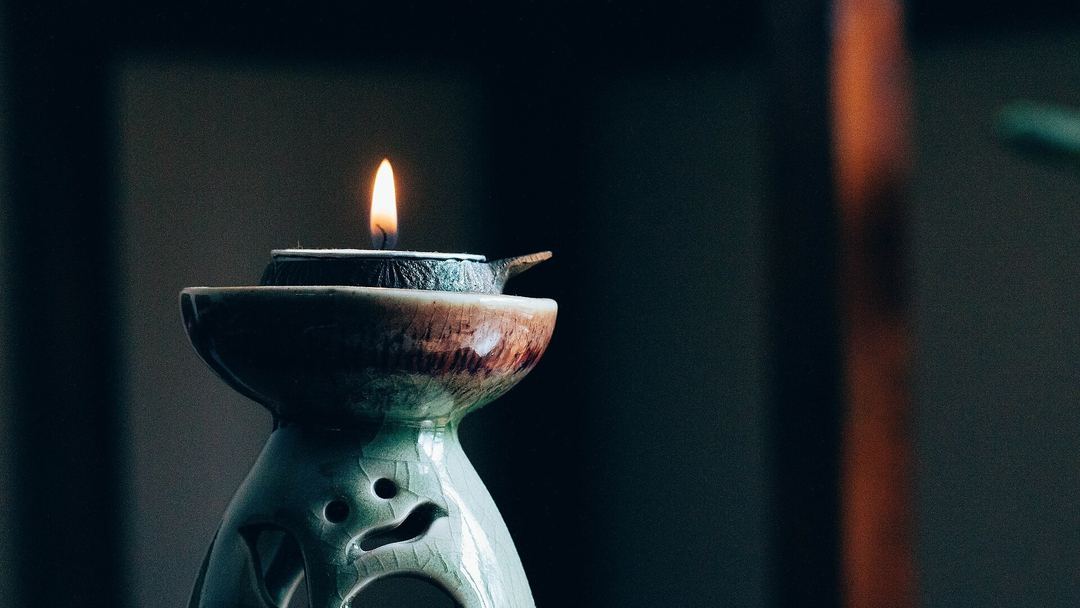
The candle. A plain, unscented candle with a steady flame works best. Scented candles can give off more smoke and soot, which irritate eyes during a long gaze. Beeswax or a simple white pillar candle are good choices. A tea light in a glass holder also works.
Height and distance. The flame should sit at eye level, so you look straight ahead without tipping your head up or down. Stack books under the holder if needed. Distance is usually about an arm's length. Too close and the brightness strains your eyes. Too far and the flame becomes too small to hold.
The room. Dim or dark, quiet and draught-free. A flame that dances in a draught makes steady gazing much harder. Turn off fans and close windows and doors.
Your seat. Sit on a cushion with your spine upright, or on a chair with feet flat. Your neck should be relaxed and level. Rest your hands on your knees, perhaps in gyan mudra, as shown in our Mudras for Healing guide.
Fire safety. Use a stable holder on a heat-proof surface, well away from curtains, papers and pets. Tie back long hair. Never leave the candle burning when you leave the room or lie down to sleep.
Alternatives to a flame. The tradition also allows a black dot on white paper, a small symbol such as OM, a star, or the moon. A dot is a good choice if you are sensitive to light, or you cannot use a flame safely.
Which part of the flame should I look at?
Most teachers suggest the tip of the wick or the brightest part of the flame just above it. Choose one spot and keep your gaze on it, rather than letting your eyes roam over the whole flame.
Can I practise trataka in daylight?
You can, but the afterimage is weaker and the flame harder to see. A darkened room gives the clearest experience. Closing curtains is usually enough.
How do you do trataka, minute by minute?
Settle your breath for a minute, then gaze softly at the flame for about a minute with as little blinking as is comfortable. Close your eyes and watch the afterimage until it fades. Repeat two or three times, then rest with your palms over your eyes.
Step 1. Sit, light the candle, and close your eyes for a minute. Breathe slowly through your nose. Let your face, jaw and shoulders soften.
Step 2. Open your eyes and look at the tip of the wick or the brightest part of the flame. Keep your eyes relaxed, as if looking at something you love rather than something you must stare down.
Step 3. Hold the gaze steadily for about one minute at first. Blink less than usual, but blink when you need to. If your eyes sting, close them and move on to the next step early.
Step 4. When your eyes water or the minute ends, close your eyes gently. You will see an afterimage of the flame against the dark.
Step 5. Keep your attention on the afterimage. If it drifts up or down, try to bring it back to the point between your eyebrows, without straining. Stay with it until it fades completely.
Step 6. Open your eyes and repeat. Two or three rounds is a full beginner session.
Step 7. To finish, rub your palms together until warm and cup them over your closed eyes for 30 seconds. Then sit for a minute with your eyes closed before you blow out the candle.
When your mind wanders. It will. Each time you notice, return to the flame or the afterimage. That return is the training.
Do I have to stop blinking completely?
No. Blinking less is part of the practice, but forcing your eyes open hurts them. Blink whenever you feel discomfort, then return to the flame. Over weeks, the gaze naturally steadies.
What should I think about during trataka?
Nothing in particular. Keep your attention on what you see. If thoughts come, notice them and go back to the flame or the afterimage. Some people silently repeat a word to help.
What is the afterimage, and what do you do with it?
The afterimage is the glowing shape of the flame you see after closing your eyes. It happens because the parts of your retina that saw the bright flame have adapted for a moment. In trataka, you use it as a point of inner focus until it fades.
What it looks like. At first it is usually a bright spot or flame shape. Within seconds it may change colour, often from yellow or white to blue, green, red or purple, and it may shrink, grow or drift. When it fades, there is just darkness.
Why it moves. The image is printed on your retina, so it moves wherever your eyes move. If it drifts upward, your eyes are drifting upward under your lids. Gently bringing it back to the centre is a quiet lesson in steadying your eyes and your attention together.
What tradition says. In yoga teaching, holding this inner image at the point between the eyebrows is where trataka turns into meditation. Teachers describe it as drawing awareness inward, and link the brow point to ajna, the third eye chakra. Our Third Eye Chakra guide covers that symbolism in depth.
What not to do. Do not chase the image if it slips away. Do not press on your eyes to make it brighter. Do not open your eyes to "recharge" it again and again in quick succession, which mostly tires them. One clean round of gaze and afterimage is better than many rushed ones.
Seeing other things. Some people see shifting colours, patterns or lights. These are normal effects of the eyes and visual system resting in darkness. If anything you see frightens you, open your eyes, look around the room, and end the session.
Why does the afterimage change colour?
Different light-sensing cells in your retina recover at different rates after the bright flame, so the colours you see shift as they adjust. It is a normal part of how vision works.
What if I see no afterimage at all?
Your room may be too bright, or your gaze too short. Darken the room, gaze for the full minute, and close your eyes gently. If you still see nothing, simply keep your attention at the brow point in the darkness.
What does a four-week trataka plan look like?
Week one: 2 rounds of 1 minute open and 1 to 2 minutes closed. Week two: 3 rounds of 1 to 2 minutes open. Week three: 2 rounds of 3 minutes open. Week four: a single 5-minute gaze, then sit with the afterimage and silence.
Week one: get comfortable. Practise daily, ideally at the same time. Two rounds of about 1 minute gazing and 1 to 2 minutes with eyes closed. Focus on a soft gaze and relaxed face. Total time: about 5 minutes including settling.
Week two: steady the gaze. Three rounds of 1 to 2 minutes gazing. Notice how often you blink and gently let it reduce, without forcing. Spend longer with the afterimage, keeping it at the centre.
Week three: lengthen. Two rounds of about 3 minutes gazing. If your eyes stay comfortable, let the closed-eye phase run until the image fully fades, then sit in the darkness for another minute.
Week four: one long sit. One gaze of up to 5 minutes, then close your eyes and stay with the afterimage and the quiet afterwards for 5 minutes or more. This is a full trataka practice of around 10 to 15 minutes.
If your eyes complain. Go back a week. Red, sore or gritty eyes the next day mean you pushed too hard. Some people stay at the week-two level for months, and that is fine.
Keeping a short note. Jot down how long you held the gaze, how steady the afterimage was, and how you felt afterwards. Over a month, you will see your attention lengthen.
A traditional variation. Some yoga traditions use the full moon as the object, which is gentle on the eyes. To pick a night for it, look up the next full moon on the free moon phase calendar on this site.
How many times a week should I practise?
Daily practice works best, even if short. Five days a week is a good realistic target. Long gaps mean you start over with a restless gaze.
Should I keep extending the time after week four?
Only if your eyes stay comfortable. Many experienced practitioners stay at 5 to 10 minutes of open gazing and spend longer in the closed-eye phase. The quality of attention matters more than the clock.
Where does trataka come from in the Hatha Yoga Pradipika?
Trataka is one of six cleansing practices, the shatkarmas, in the Hatha Yoga Pradipika, a 15th-century yoga manual. The text defines it as gazing with an unmoving eye at a small point until tears flow, and says it removes eye diseases, fatigue and sloth.
The six shatkarmas in the Hatha Yoga Pradipika are dhauti (cleansing the digestive tract), basti (a yogic enema), neti (cleaning the nose), trataka (gazing), nauli (churning the abdomen) and kapalabhati (a forceful breathing practice). They were meant to prepare the body for pranayama and meditation, especially for students with excess mucus or fat, in the text's own terms.
In chapter two, verses 31 and 32, the text describes trataka as looking intently with an unwavering gaze at a small point until tears are shed. It then says trataka eradicates all eye diseases, fatigue and sloth, and should be kept secret like a golden casket. The later Gheranda Samhita also includes trataka and links it to a kind of inner, divine sight.
Read those claims with care. The text was written centuries before modern eye medicine, and its promise to cure "all eye diseases" has not held up, as the evidence section below shows. Its description of the practice itself, though, is clear and still how trataka is taught.
Over the 20th century, teachers in India and the West made trataka more widely known, often as a concentration method linked to the third eye. Today it is taught in yoga schools as a bridge from the senses to meditation. You do not need to accept every traditional claim to value the practice as a focusing ritual.
Neti, another shatkarma, has its own guide, Neti Pot, on this site if you want to see how the cleansing practices fit together.
Is trataka part of Buddhism too?
Trataka as named is a hatha yoga practice. Buddhist meditation has a similar method, kasina practice, where a meditator focuses on a coloured disc or other object to build concentration.
Why was trataka meant to be kept secret?
Many hatha yoga texts urge secrecy so that practices are passed from teacher to student with guidance. It reflects how teaching worked then rather than a hidden danger in candle gazing itself.
What do small studies show about trataka and attention?
A few small Indian studies suggest trataka can sharpen attention and some memory measures, both straight after a session and over a few weeks. The studies are small and come from a narrow group of researchers, so treat them as promising rather than proven.
A single session. Raghavendra and Singh, in the Journal of Traditional and Complementary Medicine (2016), tested 30 healthy young men on the Stroop colour-word test, a classic measure of attention and mental flexibility. After a session of trataka, their scores were better than after a control session on another day.
Older adults. Talwadkar and colleagues, in the International Journal of Yoga (2014), randomly assigned 60 older adults to trataka or a waiting list. The trataka group practised for 26 days. On tests of memory, attention and visual scanning, they improved more than the waiting group.
What these studies cannot tell us. Both are small, both come from yoga research centres in India, and people knew which group they were in, which can colour results. We do not know how trataka compares with other kinds of focused meditation, or how long any gains last.
Eyesight. This is where the traditional claims fall down. Tiwari and colleagues, in the International Journal of Yoga (2018), randomly assigned 24 young adults with short-sightedness to eight weeks of trataka or Bates eye exercises. Neither group showed a significant change in their prescription or sharpness of vision.
The honest summary is that trataka is a reasonable way to train attention, much like other concentration practices, and it should not be used to treat eye conditions.
Can trataka help with ADHD or focus problems?
It has not been properly studied for ADHD. Some people find it a helpful focus routine. If you have ADHD, keep your treatment and treat trataka as an extra habit to try.
Does trataka help with sleep?
Some people find an evening session calming, but there is no strong research on trataka for sleep. If it leaves you wired, practise in the morning instead.
Is trataka safe for your eyes?
Gentle candle trataka is safe for most people, as long as you blink when you need to, take contact lenses out, keep sessions short, and never gaze at the sun or any very bright light. Stop if you get eye pain, lasting blurred vision or a headache.
Dry eyes. When you stare, you blink less, and fewer blinks mean a drier eye surface. That is why the eyes water. Short sessions and blinking when needed keep this harmless. If you already have dry eye disease, ask your eye doctor first and keep sessions very short.
Contact lenses. Take them out. Lenses dry faster with fewer blinks and can feel gritty or stick to the eye.
Epilepsy and flicker. Some people with photosensitive epilepsy have seizures triggered by flashing or flickering light at certain rates. A candle in a still room usually burns steadily, but a draught can make it flutter, and some electric candles flicker by design. If you have epilepsy, speak to your neurologist first, and consider a black dot instead of a flame.
Migraine. If bright light triggers your migraines, a flame in a dark room may set one off. Try a dot, keep sessions short, and stop at the first sign of an aura.
After eye surgery or infection. Wait until your eye doctor clears you for normal activity.
Never the sun. Looking at the sun, even briefly or at sunrise, can burn the retina. In 2017, doctors at New York Eye and Ear Infirmary of Mount Sinai published a case in JAMA Ophthalmology of a young woman with a crescent-shaped burn on her retina, the exact shape of the partly covered sun, after watching an eclipse without proper glasses. Damage like this can be permanent.
Warning signs. Eye pain, redness that lasts into the next day, blurred vision that does not clear with blinking, flashes or floaters you have not had before, or headaches after practice. Stop, and see an eye doctor if they persist.
Is it bad if my eyes are red after trataka?
Mild redness right after practice is common and should fade within an hour. Redness that lasts into the next day means you held the gaze too long. Shorten your sessions and blink more.
Can trataka damage my eyes?
Gentle candle gazing at a safe distance is very unlikely to cause harm. Damage comes from very bright sources like the sun, from forcing your eyes open, or from practising through pain.
Is sungazing, third eye activation or a trataka eyesight cure a scam?
Yes, in each case the promise outruns the truth, and sungazing can blind you. Sun gazing burns the retina, no course can "activate" your pineal gland, and trataka does not cure short-sightedness. Keep trataka to a candle or a dot.
Sungazing schools. Sun gazing, staring at the sun at sunrise or sunset for gradually longer periods, was popularised by Hira Ratan Manek, who claimed that from 1995 he lived on sunlight and water, with only the occasional cup of tea or buttermilk. His method is still promoted on websites, in videos and in workshops. Eye doctors have warned for decades that looking at the sun causes solar retinopathy, a burn to the central retina that can leave a permanent blind spot. Sunrise and sunset do not make it safe. No real trataka teacher uses the sun as the object.
"Third eye activation" and pineal "decalcification" courses. Online programmes sell trataka, special tones, diets, water filters or supplements to "decalcify" and "activate" the pineal gland, which they equate with the third eye. Calcium deposits in the pineal gland are common as people age and show up often on brain scans. There is no evidence that removing them is possible through these products, or that it would give anyone psychic sight. The third eye is a meaningful symbol in yoga and Hindu tradition. Turning it into a paid gland treatment is marketing.
"Throw away your glasses" promises. Some books and videos claim trataka, alone or with the Bates method, cures short-sightedness. The American Academy of Ophthalmology has found no evidence that visual training slows or reverses short-sightedness. The 2018 International Journal of Yoga trial of trataka and Bates exercises found no change in prescription after eight weeks. Going without glasses you need is dangerous, especially when driving.
Costly trataka training and apps. Paid "trataka teacher" certificates, premium apps and special "trataka candles" are not needed. No body regulates trataka teaching. A plain candle, a dark room and this guide are all the equipment there is.
What fair looks like. A drop-in yoga class or a workshop with a qualified teacher who asks about your eyes and health first is fair. A course that promises psychic powers, cured eyesight or a life without food is not.
Is it safe to look at the sun at sunrise?
No. Sunlight at sunrise is still strong enough to damage the retina with direct staring, and the damage is painless at the time, so you may not notice until later. Enjoy the sunrise without looking straight at the sun.
Can trataka open the third eye?
In yoga teaching, trataka is a method for concentrating awareness at the brow point, which the tradition calls ajna. People describe insight, calm and clearer intuition. These are inner experiences, not a physical change in the brain that a course can sell you.
Questions people ask
How long should you do trataka each day?
Beginners should start with about 1 minute of open-eyed gazing and a minute or two with the eyes closed, repeated two or three times. Over four weeks, most people build to 5 to 10 minutes in total. Longer is not better if your eyes feel strained.
Is it normal for your eyes to water during trataka?
Yes. The Hatha Yoga Pradipika describes gazing "until tears are shed", and watering is a normal response to blinking less. Close your eyes when it happens. Tears should come from gentle effort, never from forcing your eyes open against discomfort.
Can you do trataka with glasses or contact lenses?
Take contact lenses out first, because staring with fewer blinks dries the lens and the eye. Glasses are fine to keep on if you need them to see the flame clearly. Many people remove them because a slightly soft view still works for the practice.
What should you see during trataka?
With eyes open, you see the flame and, as your attention steadies, the room seems to fade around it. With eyes closed, you see an afterimage of the flame, often changing colour, that slowly fades. Some people see other lights or shapes. These are normal effects of the eye and the resting mind.
Can you do trataka before bed?
Yes. Many people find evening trataka calming, and a dark room makes the afterimage clearer. If it leaves you alert, move it to the morning. Put the candle out completely before you go to sleep.
Can I use an LED candle for trataka?
You can use a steady, non-flickering light, or a black dot on white paper. Avoid electric candles with a built-in flicker effect, since the rapid pulsing is not what the practice intends and may bother people sensitive to flicker.
Does trataka improve eyesight?
No reliable study shows that it does. A 2018 trial in the International Journal of Yoga found eight weeks of trataka did not reduce short-sightedness in young adults. Keep wearing your glasses or lenses and see an optometrist for vision changes.
What does today hold for you?
Pop in your birthday. Your reading shows up right here. No email, no account.
Related topics: trataka meditation, trataka candle, trataka benefits, how to do trataka, candle gazing meditation, trataka meditation benefits, trataka side effects, trataka for beginners