Curanderismo: Mexican Folk Healing and How to Find a Real Curandera
By DailyDestiny Editorial Team
The short answer
Curanderismo is the traditional healing system of Mexico and Mexican-American communities. A curandero (man) or curandera (woman) treats body, mind and spirit using prayer, herbs, massage and cleansing rituals called limpias, often for folk illnesses such as susto and mal de ojo. It blends Indigenous Mexican medicine, Spanish folk medicine and Catholic faith, and many families use it alongside modern doctors.
Maybe it is your abuela's rue and prayers, or a healer your family still trusts. Here is what curanderismo really is, where it comes from, how it sits beside modern medicine, and how to find an honest curandera without getting hurt.
On this page
What does curanderismo mean, and who are curanderos?
Somebody who looks up curanderismo usually has a grandmother, a neighbour or a memory behind the search: a sprig of rue, a whispered prayer, a warm hand on a feverish child.
Maybe you remember being small and sick, and your abuela brushing you with fresh herbs while she prayed under her breath. Maybe you are pregnant, and your aunt keeps telling you to visit the woman down the street. Maybe a friend swears her back pain finally eased after a sobadora worked on it. You want to understand what this tradition really is.
The word comes from the Spanish curar, to heal or cure. Curanderismo is not one fixed school. It changes from village to village, from family to family, and from healer to healer. What unites it is a view that health means balance, and that illness can have physical, emotional and spiritual causes all at once.
For millions of people in Mexico and the United States, curanderismo is simply part of life. A curandera might be a respected grandmother who rubs a child's sore stomach, a skilled bonesetter in a market town, or a healer who receives visitors from miles away.
In 1981, the anthropologists Robert Trotter and Juan Antonio Chavira published Curanderismo: Mexican American Folk Healing, based on fieldwork in South Texas. They described healers working on three levels: the material level, with herbs, massage and objects; the spiritual level, with prayer and contact with the spirit world; and the mental level, with focused intention and counselling. That framework still helps outsiders see how wide the tradition is.
Check with a doctor first if you are pregnant, breastfeeding, or trying to conceive, because some traditional herbs, especially rue (ruda), are unsafe in pregnancy. Also check if you take prescription medicine, especially for diabetes, blood pressure or blood thinning, if you have kidney or liver disease, or if the person seeking help is a baby or young child. Herbs can interact with medicines, and some folk illnesses look like serious medical conditions.
What is a curandera in English?
There is no exact English word. "Folk healer" or "traditional healer" is the closest. Many people keep the Spanish word because English terms lose its mix of medicine, prayer and community role.
Is curanderismo still practised today?
Yes, widely, in Mexico and across the United States, especially in Texas, New Mexico, Arizona and California. It is also practised among other Latin American communities, with local differences.
Where did curanderismo come from?
Curanderismo grew out of the meeting of Indigenous Mexican medicine, especially that of the Nahua peoples, with Spanish folk medicine and Catholicism after the conquest of 1521. Over centuries it absorbed African and other influences too, becoming a distinct tradition of its own.
Aztec healers had deep knowledge of plants. In 1552, a Nahua physician named Martín de la Cruz wrote a herbal of Mexican medicinal plants, translated into Latin by Juan Badiano. It is often called the Badianus manuscript, and it is one of the earliest records of Indigenous American plant medicine.
Spanish influences. The Spanish brought the old European idea of the humours, which sorted foods, illnesses and remedies into hot and cold. That idea still shapes curanderismo: some illnesses are "cold" and treated with "hot" herbs, and the reverse. Spain itself had absorbed medical knowledge from Arabic medicine during the centuries of Muslim rule, so curanderismo carries those traces too.
Catholic faith. Prayer to God, the Virgin of Guadalupe and the saints became central. Many curanderos describe their healing ability as a don, a gift from God.
Famous healers. The tradition has its own revered figures. Don Pedrito Jaramillo (1829 to 1907) healed thousands in South Texas and was known for not charging. His shrine near Falfurrias, Texas, still draws visitors. Teresa Urrea, called the Saint of Cabora, was a celebrated healer on both sides of the border in the late nineteenth century. Niño Fidencio (1898 to 1938) drew crowds to Espinazo, in Nuevo León, where pilgrims still gather twice a year.
Is curanderismo related to shamanism?
Some writers compare them, but curanderismo has its own history and terms. The word shaman comes from Siberia and is often stretched too far, as the guide Shamanism: One Word Doing Too Much Work on this site explains.
Is curanderismo the same as Santería?
No. Santería, or Lucumí, is an Afro-Cuban religion with initiations and orishas. Curanderismo is a Mexican healing tradition rooted in Catholic prayer and Indigenous plant knowledge. They can overlap in botánicas, but they are different paths.
What do the yerbera, sobadora, partera and consejera each do?
Curanderos often specialise. A yerbera knows herbs, a sobadora treats with massage, a huesera sets bones and joints, a partera is a traditional midwife, and a consejera offers counsel. Some healers do many of these. Others focus on one.
Yerbero or yerbera. The herbalist. They know which plants grow nearby, how to prepare teas, baths and poultices, and which plants to avoid. Many work from markets or botánicas.
Sobador or sobadora. The massage healer. They treat aches, sprains, stiff muscles and digestive complaints with firm, skilled massage, often with oils or ointments.
Huesero or huesera. The bonesetter, treating dislocations, sprains and joint problems.
Partera. The traditional midwife, who cares for women through pregnancy, birth and recovery. Traditional midwives remain important in parts of rural Mexico. In the United States, midwifery is regulated by each state, so a partera attending births there may need a licence depending on the state.
Consejero or consejera. A counsellor who listens and offers guidance on family conflicts, grief, and life problems, often with prayer.
Espiritualista and rezandera. Some healers work mainly with prayer and the spirit world. A rezandera leads prayers and novenas for the sick.
The curandero total. A healer recognised as skilled in many areas, often with a long reputation in the community.
Being honest about limits. A good sobadora can ease a stiff back. She cannot safely set a complex fracture. A partera can support a normal birth. She is not equipped for a birth that turns into an emergency. The best traditional healers know their limits and send people to a doctor or hospital when needed.
What does a sobada feel like?
A sobada is usually a firm, deep massage, sometimes uncomfortable, especially on knotted muscles. Tell the sobadora if anything is too painful. Avoid deep massage over a recent injury, a swollen leg or a blood clot.
Is a huesero the same as a chiropractor?
No. A chiropractor is trained and licensed in a formal program. A huesero learns through apprenticeship. For a suspected broken bone, get an X-ray from a doctor first.
What happens during a limpia?
A limpia is a spiritual cleansing. The curandera prays while sweeping the body with fresh herbs, an egg, smoke or other objects, to draw out negative energy, fright or envy. A typical limpia lasts from a few minutes to half an hour.
You usually stand or sit while the curandera prays, often the Our Father, the Hail Mary or her own prayers. She brushes or taps a bundle of fresh herbs, such as rue, rosemary, basil or pirul, over your body from head to feet. She may pass copal smoke around you, or spray a little water, alcohol or perfumed water. Some healers use a raw egg, which is then cracked into water and read. That egg ritual has its own guide on this site, Egg Cleanse Meaning, so it is not repeated here.
What it might feel like. Many people say they feel calm, lighter or sleepy afterwards. Some feel emotional. The healer may tell you to rest, avoid cold drinks or stay out of the wind for the rest of the day.
What the herbs mean. Rue (ruda) is the classic cleansing herb, believed to absorb negative energy. Rosemary (romero) is linked to protection and clarity. Basil (albahaca) is linked to sweetness and good fortune. Pirul, the Peruvian pepper tree, is common in central Mexico. Used herbs are usually thrown away, burned or buried, not reused.
How often. Some people have a single limpia after a fright or a bad run of luck. Others see a curandera every few weeks. A healer who insists you need many paid limpias, with rising prices, is a concern, as the scam section below explains.
Safety notes. Rue sap can cause burns and blisters on skin exposed to sunlight, so rinse it off if your skin is sensitive. Keep copal and candles away from children and curtains. Anyone with asthma may want to skip the smoke.
Can you do a limpia on yourself?
Many families do simple home limpias with herbs and prayer, especially for children. More serious cases are traditionally taken to a curandera. If you do one at home, keep it simple and prayerful.
What is the purpose of a limpia?
To remove spiritual heaviness, fright, envy or bad energy, and to restore balance. Many people also find it simply comforting to be prayed over and cared for.
What are susto, mal de ojo and empacho?
They are three of the most common folk illnesses that curanderas treat. Susto is fright sickness after a shock. Mal de ojo is the evil eye, often affecting babies. Empacho is a blockage in the stomach or intestines, often blamed on food that "stuck".
Susto. People believe a sudden fright, such as a car accident, a dog attack or bad news, can startle the spirit out of the body. Signs are said to include tiredness, poor sleep, loss of appetite, sadness and nervousness. The curandera does a limpia, prays, and calls the person's spirit back, often by name.
Mal de ojo. A strong gaze, usually admiring or envious, is believed to cause illness, especially in babies and young children. Signs are said to include crying, fever, vomiting and restlessness. Protection includes a red string or bracelet, or an ojo de venado seed amulet. Treatment includes a limpia, often with an egg.
Empacho. Believed to be a ball of undigested food stuck in the gut. Signs include stomach pain, bloating, diarrhoea or constipation, and lack of appetite. Traditional treatment includes stomach massage, rolling or pulling the skin of the back, and herbal teas.
Where the medical risk lies. These folk names can describe real medical problems. Susto symptoms can overlap with depression, anxiety, post-traumatic stress or physical illness. A baby's "mal de ojo" with fever, vomiting or poor feeding can be a serious infection. "Empacho" with severe pain, vomiting or blood in the stool can be appendicitis, dehydration or a bowel blockage.
When to see a doctor promptly. See a doctor quickly for any fever in a baby under three months, a child who is not drinking, very sleepy or has fewer wet nappies, severe stomach pain, vomiting that will not stop, or symptoms that are getting worse. A limpia and a doctor's visit can happen on the same day. Many families do both.
The most important empacho warning. Some families have given children powders called azarcon or greta for empacho. They are lead compounds, and they have poisoned children in the United States. They are covered in the scam section below.
Is susto recognised by doctors?
It has been studied by medical anthropologists as a cultural way of describing distress. Many doctors in the US Southwest know the word and take it seriously as a sign that a person is struggling, while also checking for medical causes.
What is the red bracelet for mal de ojo?
A red string or beaded bracelet, often with an eye charm or an ojo de venado seed, is believed to protect babies from the evil eye. Make sure any bracelet on a baby cannot be chewed off and swallowed.
Which healing herbs do curanderas use, and which need caution?
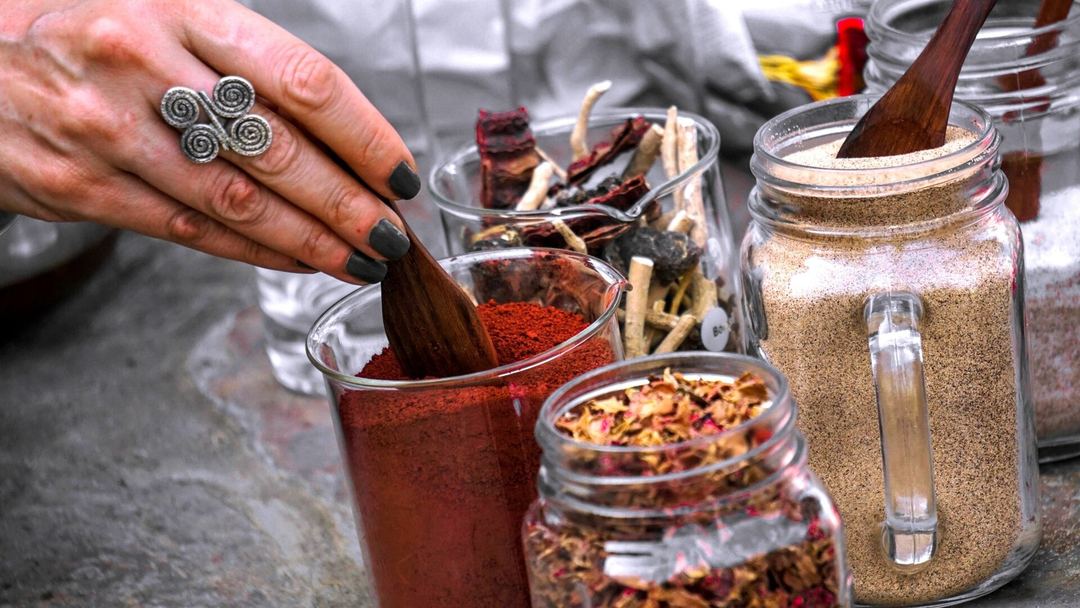
Common curanderismo herbs include chamomile (manzanilla) for stomach upsets and nerves, spearmint (yerba buena) for digestion, rue (ruda) for cleansing, rosemary (romero), estafiate for stomach complaints, and Mexican arnica (árnica) rubbed on bruises. Most are used as teas, baths or ointments.
The everyday kitchen herbs, such as manzanilla and yerba buena, are gentle for most adults as weak teas. Others need real care. Rue is the clearest example: it has a long history of being used to bring on miscarriage, so it should never be taken by mouth in pregnancy, and its sap can burn skin in sunlight.
Mistaken identity. Herbs sold by common names can be the wrong plant. The US Food and Drug Administration has described a case in which a toxic Senecio plant, mistaken for gordolobo, was made into a cough remedy and given to two infants, who were poisoned. Senecio plants contain compounds that damage the liver. Buy herbs from a trusted source and ask the Latin name when you can.
Interactions. Some herbs affect blood sugar, blood pressure or blood clotting. If you take medicine for any of these, tell your doctor what you drink, even "just tea". Never stop a prescribed medicine because of an herbal remedy.
Reliable information. For safety facts on individual herbs, the US National Center for Complementary and Integrative Health and the NIH Office of Dietary Supplements publish free, plain-language fact sheets. The guide Herbalism for Beginners on this site covers safe preparation and general cautions.
Children and herbs. Children are smaller and more sensitive. Keep teas weak, avoid essential oils by mouth, and check with a doctor before giving any herb to a baby.
Is manzanilla tea safe for babies?
Many families give weak chamomile tea, but babies under six months should usually have only breast milk or formula. Check with your doctor before giving any tea to a baby.
What is estafiate used for?
Estafiate, a Mexican wormwood, is traditionally used as a bitter tea for stomach pain and indigestion. Like other wormwoods, it is not for pregnancy, and it should be used only in small amounts.
How does curanderismo work alongside modern medicine?
For most families, curanderismo and modern medicine are not rivals. People often see a curandera for the spiritual and emotional side of illness and a doctor for the physical side, and the safest path is to use both and tell each one what you are doing.
A curandera can offer things a busy clinic often cannot: time, prayer, touch, a shared language and culture, and a sense of being cared for by your own community. A doctor can offer tests, antibiotics, surgery, insulin and treatments that save lives. Each fills gaps the other leaves.
Tell your doctor. Many patients do not mention folk healing for fear of being judged. Doctors need to know about herbs and remedies to avoid interactions and to spot problems such as lead exposure. A good doctor will ask respectfully.
Tell your curandera. Let her know about your diagnosis and medicines. A trustworthy healer will support you in keeping up with treatment, and will never tell you to stop insulin, blood pressure medicine or chemotherapy.
Diabetes and chronic illness. Diabetes is common in many Mexican-American communities. Traditional remedies, such as nopal cactus, are popular. They can be part of a healthy diet, but they do not replace prescribed treatment, and they can change blood sugar, so tell your doctor.
Health systems are learning. Some clinics and medical schools in the US Southwest teach staff about curanderismo so they can care for patients with respect. The University of New Mexico, through Eliseo "Cheo" Torres, has offered curanderismo courses for many years.
Should you tell a doctor you saw a curandera?
Yes. It helps your doctor understand your care and check for herb interactions or contamination. Most doctors in areas with large Mexican-American communities are familiar with curanderismo.
Can a curandera help with mental health?
Many people feel comforted and supported by a curandera, especially for grief and fright. For depression, anxiety or trauma that lasts or disrupts your life, see a doctor or counsellor as well.
How do you find a genuine curandera and approach her respectfully?
Ask people you trust, such as relatives, neighbours, church members or friends who have been helped. Genuine curanderas usually build their reputation by word of mouth over many years, not through adverts promising miracles.
When you find someone, approach with humility. Explain why you came, ask how she works, and ask what she would like in return. Many healers accept a donation, food or a gift rather than a fixed fee. Follow her instructions, such as bringing an egg, herbs or a candle, and respect her prayers even if you hold a different faith.
Signs of a trustworthy healer. She has a long-standing presence in the community. Local families know her. She prays and treats without pushing extra services. She tells you to see a doctor when needed. She does not claim she can cure cancer or other serious diseases. She does not frighten you with talk of curses.
What to bring. Ask in advance. Common requests are an egg, fresh herbs, a candle, or a photograph if the limpia is for an absent family member. Bring cash for a donation if that is the custom.
Language and culture. Many curanderas speak Spanish or an Indigenous language. Bring someone to interpret if you need it. Do not record or photograph without asking.
Learning more. If you want to understand the tradition before or after a visit, the University of New Mexico's online courses on Coursera, taught by Eliseo "Cheo" Torres, are a gentle start. Books by Torres, and the work of Trotter and Chavira, give deeper background.
How much should you give a curandera?
There is no fixed amount. Many people give what they can afford. Ask a relative or the person who referred you what is customary in your community. A healer who sets a high price and then keeps raising it is a warning sign.
Can a non-Latino person see a curandera?
Many curanderas welcome anyone who comes with respect. Go through someone who knows her if possible, accept her ways, and remember you are a guest in a living tradition.
How do you spot a fake curandero, a limpia scam or a dangerous remedy?
Be wary of anyone who says you are cursed and then charges you to remove it, asks for cash or jewellery during a ritual, raises their price after each session, or sells powders for children's stomach problems. These patterns have hurt real families, and they are not part of honest curanderismo.
The classic con begins with a free or cheap reading, a limpia or an egg cleanse. The "healer" then announces a curse, brujería or envidia. To remove it, they need a trabajo, a work, which costs hundreds of dollars, then more. The pattern is described in detail in Curse Removal Scams on this site. What is specific to curanderismo is that the scammer often borrows the trusted language of limpias and prayer, and calls himself a curandero while really selling fear.
Door-to-door limpia thefts. In May 2023, police in Mesa, Arizona, warned about scammers knocking on doors, mostly in the Hispanic community, and offering a free limpia. They gained trust by claiming to be a friend of the family or a neighbour. Then they asked residents to bring out cash and jewellery, had them put the valuables in a shirt, said they would pray for them, and told them not to touch the bundle for an hour. When the victims opened it, the valuables were gone.
Social-media and distance healers. Online accounts sell distance limpias and curse removal for payment by app transfer, often after reading a photo or an egg in a video. Many ask for more money after each session, claiming the curse is stronger than expected. A real community curandera rarely needs your bank details.
Lead in folk remedies. In 1983, the US Centers for Disease Control and Prevention reported lead poisoning in children given azarcon and greta, bright orange and yellow powders used for stomach complaints such as empacho. Their lead content ranged from 70 percent to more than 90 percent. In one case, a child died, with azarcon poisoning suspected as the cause. A 1982 survey in Los Angeles County estimated that roughly 7 to 12 percent of Mexican-Hispanic families had used them. Health departments in California, Arizona and other states still warn against them. Never give these powders to anyone, and if a child has had them, ask a doctor for a blood lead test.
What fair looks like. Honest curanderas are known in their community, accept a modest donation or a fair, stated fee, do not demand valuables, do not frighten you with curses to sell more work, and send you to a doctor when you need one. Don Pedrito Jaramillo, the most revered healer in South Texas, was known for refusing payment. That spirit of service, not fear, is the heart of curanderismo, and it is still very much alive in the healers who carry it on.
What should you do if you were scammed by a fake curandero?
Report it to your local police, even if you feel embarrassed. In the United States, you can also report fraud to the Federal Trade Commission. Keep receipts, messages and payment records.
How do you know if a remedy contains lead?
You cannot tell by looking. Bright orange or yellow powders sold for empacho are a red flag. Ask your local health department, and ask a doctor for a blood lead test if a child has taken one.
Is a high price for a limpia always a scam?
Not always, since some healers charge for their time. But a price that keeps rising, threats about curses, or demands for jewellery and cash during a ritual are clear warning signs.
Questions people ask
What is the difference between a curandero and a brujo?
A curandero or curandera is a healer who works with prayer, herbs, massage and ritual to restore health and balance. A brujo or bruja is a word for a witch or sorcerer, often associated with harmful magic in popular belief. Many curanderas firmly reject being called brujas, and the two should not be confused.
Is curanderismo Catholic?
Much of it is. Most curanderos pray to God, Jesus, the Virgin of Guadalupe and the saints, and many use holy water, candles and Catholic prayers such as the Our Father. It also carries Indigenous Mexican and Spanish folk elements. The Church's official stance varies, but many curanderos see their work as a gift from God.
Do curanderas charge for healing?
Many community curanderas accept a donation, or whatever a family can give, rather than setting a fee. Don Pedrito Jaramillo, the famous Texas healer, was known for not charging. Some healers do charge, especially for longer sessions. Very high or rising fees, especially for curse removal, are a warning sign.
What is susto?
Susto is a folk illness believed to follow a sudden fright, such as an accident or a shock. People describe tiredness, poor sleep, loss of appetite and low mood, and say the spirit was frightened from the body. A curandera treats it with a limpia, prayer and calling the spirit back. Similar symptoms can also come from depression, anxiety or physical illness, so see a doctor too.
What is mal de ojo?
Mal de ojo, the evil eye, is believed to be caused by an admiring or envious gaze, often toward babies. Signs are said to include crying, fever and restlessness. Traditional protection includes a red bracelet, and treatment includes a limpia. A baby with a fever, especially under three months old, needs a doctor promptly.
Can you learn curanderismo online?
You can learn about it. The University of New Mexico offers a series of online courses on Coursera taught by Eliseo "Cheo" Torres, covering plants, the body, and mind and spirit. Becoming a curandera traditionally takes years of apprenticeship with an experienced healer, often within a family or community.
Are azarcon and greta safe?
No. Azarcon and greta are bright orange and yellow powders given for empacho, but they are lead compounds. A 1983 CDC report found their total lead content ranged from 70 percent to more than 90 percent, and children treated with them suffered lead poisoning. In one family, a child died and lead poisoning from azarcon was the suspected cause. Do not give them to anyone.
What does today hold for you?
Pop in your birthday. Your reading shows up right here. No email, no account.
Related topics: curanderismo, curanderismo meaning, curandero meaning, curandera meaning, curanderismo practices, curanderismo herbs, what is a limpia, susto and mal de ojo, curandera near me