Choosing Our Wedding Date From the Tong Shu, One Crossed-Out Date at a Time
By DailyDestiny Editorial Team
Mei Ling wanted a Saturday in September. Her grandmother wanted a date the almanac approved. This is how a Chinese-Malaysian family in Ipoh worked through five candidate dates, one temple consultation and a lost hotel deposit to find a wedding day everyone could live with.
On this page
The red book on the kopitiam table
If your family keeps a red almanac on the altar shelf and your wedding plans have just met it, you are in a conversation many Chinese couples have, and it often goes better than expected.
This is a composite story, built from experiences people commonly share, with names and details changed.
My name is Mei Ling. I grew up in Ipoh, I work in Kuala Lumpur, and in early 2025 I got engaged to Jason, who I met at a friend's badminton session in Petaling Jaya. I was 29. Jason was 31. We had a date in mind before we had a ring: a Saturday in mid September, when the rain is lighter and our friends from Singapore could drive up after work on Friday.
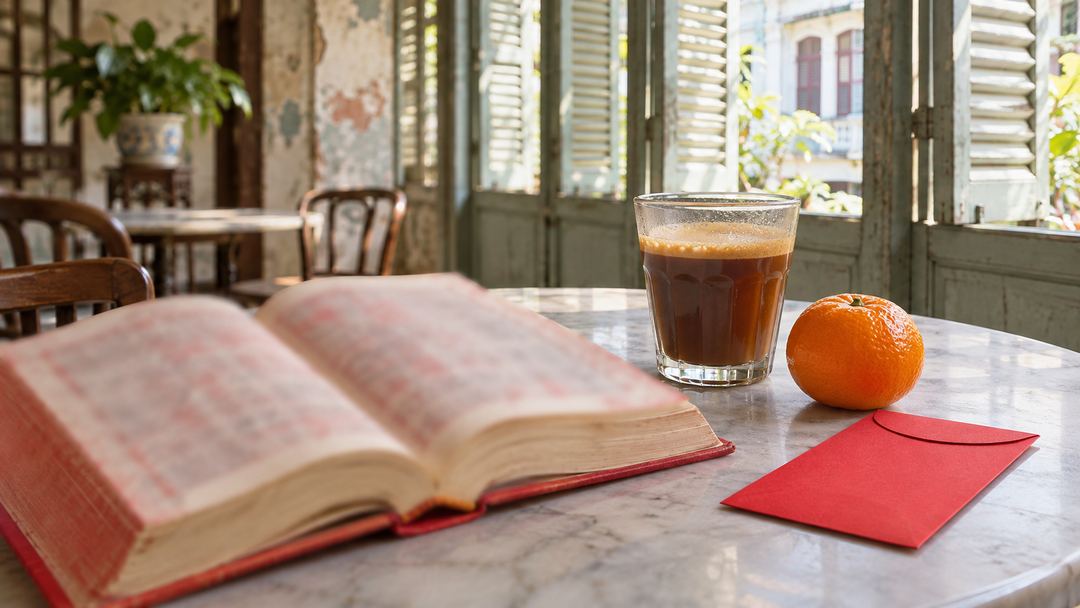
My grandmother, Ah Ma, had a different starting point. She came to the first family dinner after the engagement with the Tong Shu in a plastic bag. It is a thick red almanac, printed on thin paper, with columns for every day of the year. She buys a new one for RM15 from the same stationery shop each Lunar New Year, keeps it on the altar shelf and throws the old one away. She put it on the marble table at the kopitiam between the kopi and the chicken rice and said, in Cantonese, that we would not pick anything until someone who understood it had looked.
Jason's family is Hokkien and less strict. His mother said she was happy with any weekend. My mother said nothing, which in our family means she agreed with Ah Ma.
So what follows is the shortlist. We had five dates. Four were crossed out, and each one taught me something about how this works in practice, and about my family.
Date one: a Saturday in mid September
This was our date, the one Jason and I chose over teh tarik before we told anyone. It lasted about four minutes once Ah Ma opened the book.
In 2025 the seventh lunar month, the Hungry Ghost month, ran from late August to late September. Our Saturday fell right in the middle of it. In my family nobody marries, moves house or buys a car in that month. The almanac did not need to say anything about the day itself. The month ruled it out.
I argued a little. I said my colleagues in KL get married whenever the venue is free. Ah Ma said my colleagues could do what they liked. My mother said quietly that Ah Ma was 86 and we could give her this one. I gave her this one.
What I felt was annoyed. Looking back, I also felt relieved that the first decision had been made for me. Planning a wedding is hundreds of small choices, and having one of them settled by a calendar older than all of us was strangely restful.
Date two: a Sunday in mid August
My counter-offer was a weekend before the ghost month began. 2025 had a leap sixth lunar month, so the calendar was stretched, and there was a gap in mid August, just before it, that looked safe to me.
This was where we first disagreed among ourselves about the rules. My aunt from Taiping said some people avoid weddings in a leap month. Ah Ma had never heard that. Jason's mother had heard it from a friend in Penang. Nobody could say where it came from.
We agreed the family could not settle it at the table, and that we needed someone outside the family to read the book for us. That was the moment the date selection stopped being a dinner conversation and became an appointment.
The appointment at the temple
Ah Ma has gone to the same temple near Old Town for forty years. A man there, who everyone calls Sifu, does date selection for weddings, house moves and shop openings. You give him both people's dates and hours of birth and a window of months, and a week later he gives you a short list on red paper.
The fee was RM288. Ah Ma paid it and would not let me pay her back. I wrote down everything he said in my phone afterwards, so I remember it well.
He started with our animals. I was born in 1996, a Rat year. Jason was born in 1994, a Dog year. Each day in the almanac clashes with one animal, so any day that clashed with the Rat or the Dog was out. He also checked the parents' animals, which I had not expected, and said a day that clashed with a parent was not ideal but could be accepted if the couple's days were good.
He said the leap month was fine for us, which settled the argument between my aunt and Ah Ma without anyone losing face. Then he said the mid August Sunday clashed with the Dog, so it was out anyway. Jason laughed. Ah Ma did not.
He gave us three dates between October and December, ranked. He also gave us a time window for the groom to arrive at my family home for the door games, and a direction for me to face when I left the house. I had not known that was part of it.
Date three: Sifu's first choice, in October
His top date was a Saturday in October. We were delighted for about a day. Then we rang the hotel in Ipoh where we wanted the dinner, and they laughed kindly and said every Chinese couple in Perak wanted that Saturday. The ballroom had been booked since the previous year.
This is something nobody tells you. A good date in the almanac is a good date for everyone who reads the almanac. The best days fill first, the halls know it, and some charge more for them. Two other hotels gave us the same answer.
We could have had the date with a smaller restaurant. Jason's parents had promised a 40-table dinner to their side, so a restaurant was not possible without a family negotiation we did not have the energy for.
Date four: a Saturday in November, and the deposit
Sifu's second choice was in November. The hotel had it. We paid a RM2,000 deposit the same afternoon, because the sales manager said another couple was asking.
A week later Jason's mother called. She had shown the date to her own temple aunty in Klang, who said the day clashed with Jason's father's animal. Sifu had told us about this and said it was acceptable. The Klang aunty said it was not.
This was the hardest week of the whole engagement. Two readers looked at the same book and the same birth dates and gave different advice. I asked Sifu about it on the phone. He was calm. He said there are different schools, and a parent's clash is a matter of how careful a family wants to be. He did not change his answer.
Jason and I talked late into the night in his car outside my flat. We decided his father's comfort mattered more than the deposit. His father is a quiet man who does not ask for things. When Jason told him we would move it, he said we did not have to, and then thanked him three times in the same phone call. We lost the RM2,000. The hotel would not move it to another date because the new one was in a different pricing period.
Date five: the Sunday we actually married
Sifu's third choice was a Sunday in early December. It clashed with nobody we knew of. The hotel had it because it was a Sunday and the price was lower. Our Singapore friends had to take the Monday off, and two of them could not come.
The day itself was hot and then rainy in the afternoon, which my aunt said was lucky and which I would have called inconvenient. Jason arrived at the house inside the time window, partly because his best man had worked out the traffic from Ipoh Garden to the minute. I faced the direction Sifu gave when I stepped out. I felt a bit silly and I also felt that my grandmother, standing at the door in her good blouse, was having one of the happiest mornings of her year.
What held up, a year later
We have been married for almost a year. I cannot tell you whether the date was lucky. Nobody can. We have had a good year and a hard month when Jason's company restructured, and I do not connect either of those to a Sunday in December.
What the almanac did give us was a shared process. Every family has opinions about a wedding. The Tong Shu gave ours a single place to put them, and an outside person to make the final call. When Ah Ma and my aunt disagreed, the book and Sifu were the referee, and nobody had to win against a relative.
What did not hold up was the idea that the book has one answer. Two readers gave us two answers about the same day. The best dates were also the most crowded and the most expensive. And the cost of being careful landed unevenly: on our Singapore friends, on our deposit, and on my patience.
If you are going through this now, my practical advice is short. Ask your family for every rule they care about before you book anything. Get the date selection done first and the venue second. Ask the reader to rank more than three dates. And decide in advance, as a couple, whose comfort you will put first if two readers disagree. For us it was Jason's father, and I would make the same choice again.
If your family also looks at Western astrology, the guide Best Wedding Dates 2027 sets out how almanac lucky days, numerology and planetary timing compare. For the animals themselves, Year of the Rat and Year of the Dog describe the traditional pairings, which in our case Sifu said were fine, a relief to Ah Ma that she mentioned at the wedding dinner, twice.
Questions people ask
What is the Tong Shu?
The Tong Shu, also written Tung Shing, is the Chinese almanac printed fresh each year. For every day it lists activities considered favourable or unfavourable, such as marrying, moving house or starting work, and which zodiac animal the day clashes with. Many families in Malaysia, Singapore and Hong Kong keep a copy at home and take bigger decisions, like a wedding date, to a temple or a date-selection master who reads it alongside the couple's birth details.
How much did the date selection cost?
In this story the family paid RM288 to a temple date-selection master in Ipoh, a figure chosen partly because eight is a lucky number in Cantonese. The almanac itself cost RM15 from a stationery shop. The larger cost was a RM2,000 hotel deposit the couple lost when they moved the date after booking the ballroom.
Do you have to avoid the Hungry Ghost month for a wedding?
Many Chinese families avoid weddings during the seventh lunar month, when the gates of the underworld are said to be open. It is a custom, and how strictly families keep it varies a great deal. In 2025 the seventh lunar month ran from late August to late September, which is why the narrator's preferred September date was the first one crossed out.
What does today hold for you?
Pop in your birthday. Your reading shows up right here. No email, no account.
Related topics: tong shu wedding date, chinese almanac wedding date, auspicious wedding date chinese, tung shing wedding, chinese wedding date selection malaysia, hungry ghost month wedding, zodiac clash wedding date